Deferred Revenue Rollforward & ASC 606 SaaS Revenue Recognition Waterfall Excel Template
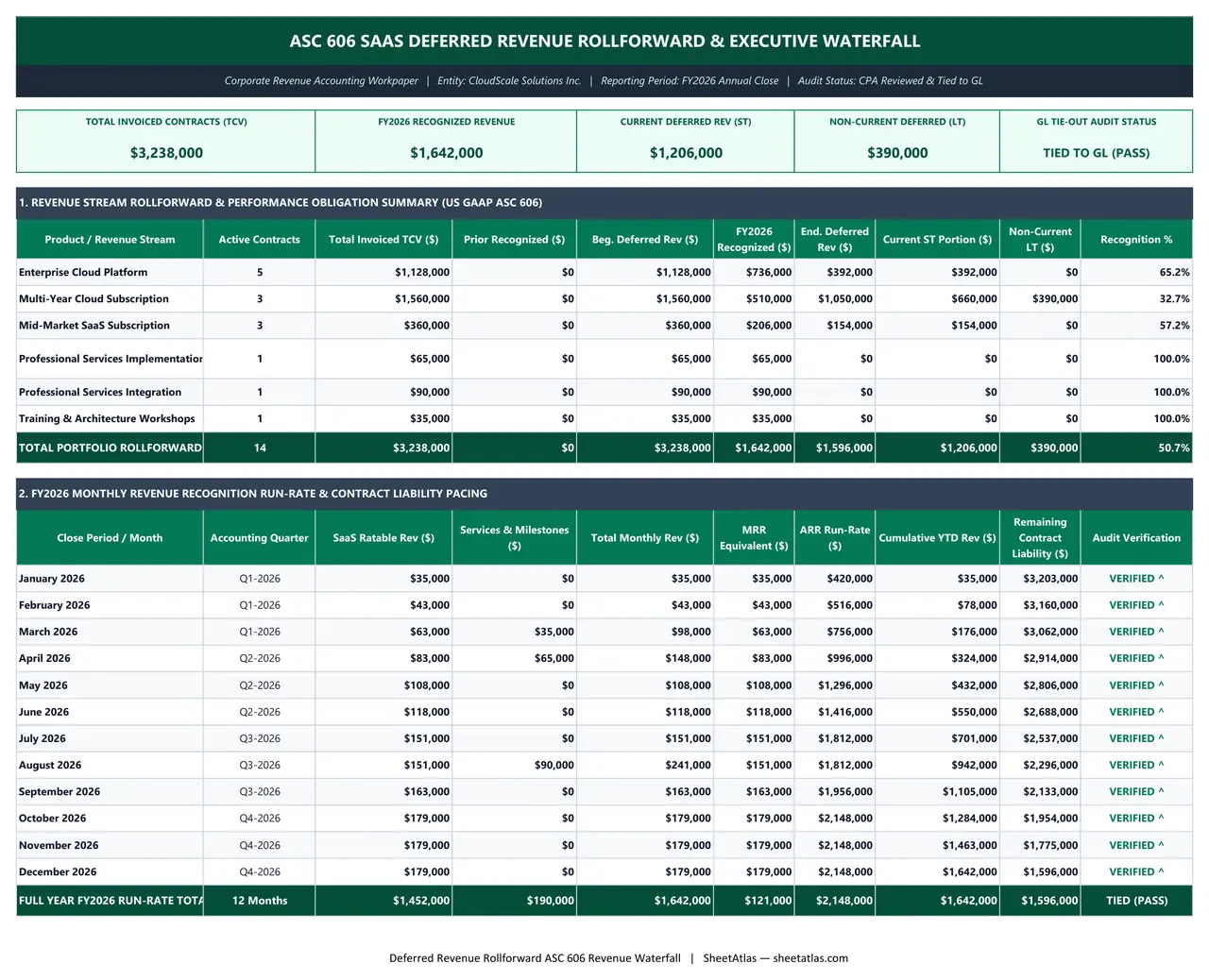
01_Executive_Summary_KPIs — Interactive Spreadsheet
| # | A | B | C | D | E | F | G | H | I | J | K |
|---|---|---|---|---|---|---|---|---|---|---|---|
| 1 | ASC 606 SAAS DEFERRED REVENUE ROLLFORWARD & EXECUTIVE WATERFALL | ||||||||||
| 2 | Corporate Revenue Accounting Workpaper | Entity: CloudScale Solutions Inc. | Reporting Period: FY2026 Annual Close | Audit Status: CPA Reviewed & Tied to GL | ||||||||||
| 3 | |||||||||||
| 4 | TOTAL INVOICED CONTRACTS (TCV) | FY2026 RECOGNIZED REVENUE | CURRENT DEFERRED REV (ST) | NON-CURRENT DEFERRED (LT) | GL TIE-OUT AUDIT STATUS | ||||||
| 5 | $3,238,000 | $1,642,000 | $1,206,000 | $390,000 | TIED TO GL (PASS) | ||||||
| 6 | |||||||||||
| 7 | 1. REVENUE STREAM ROLLFORWARD & PERFORMANCE OBLIGATION SUMMARY (US GAAP ASC 606) | ||||||||||
| 8 | Product / Revenue Stream | Active Contracts | Total Invoiced TCV ($) | Prior Recognized ($) | Beg. Deferred Rev ($) | FY2026 Recognized ($) | End. Deferred Rev ($) | Current ST Portion ($) | Non-Current LT ($) | Recognition % | |
| 9 | Enterprise Cloud Platform | 5 | $1,128,000 | $0 | $1,128,000 | $736,000 | $392,000 | $392,000 | $0 | 65.2% | |
| 10 | Multi-Year Cloud Subscription | 3 | $1,560,000 | $0 | $1,560,000 | $510,000 | $1,050,000 | $660,000 | $390,000 | 32.7% | |
| 11 | Mid-Market SaaS Subscription | 3 | $360,000 | $0 | $360,000 | $206,000 | $154,000 | $154,000 | $0 | 57.2% | |
| 12 | Professional Services Implementation | 1 | $65,000 | $0 | $65,000 | $65,000 | $0 | $0 | $0 | 100.0% | |
| 13 | Professional Services Integration | 1 | $90,000 | $0 | $90,000 | $90,000 | $0 | $0 | $0 | 100.0% | |
| 14 | Training & Architecture Workshops | 1 | $35,000 | $0 | $35,000 | $35,000 | $0 | $0 | $0 | 100.0% | |
| 15 | TOTAL PORTFOLIO ROLLFORWARD | 14 | $3,238,000 | $0 | $3,238,000 | $1,642,000 | $1,596,000 | $1,206,000 | $390,000 | 50.7% | |
| 16 | |||||||||||
| 17 | 2. FY2026 MONTHLY REVENUE RECOGNITION RUN-RATE & CONTRACT LIABILITY PACING | ||||||||||
| 18 | Close Period / Month | Accounting Quarter | SaaS Ratable Rev ($) | Services & Milestones ($) | Total Monthly Rev ($) | MRR Equivalent ($) | ARR Run-Rate ($) | Cumulative YTD Rev ($) | Remaining Contract Liability ($) | Audit Verification | |
| 19 | January 2026 | Q1-2026 | $35,000 | $0 | $35,000 | $35,000 | $420,000 | $35,000 | $3,203,000 | VERIFIED ^ | |
| 20 | February 2026 | Q1-2026 | $43,000 | $0 | $43,000 | $43,000 | $516,000 | $78,000 | $3,160,000 | VERIFIED ^ | |
| 21 | March 2026 | Q1-2026 | $63,000 | $35,000 | $98,000 | $63,000 | $756,000 | $176,000 | $3,062,000 | VERIFIED ^ | |
| 22 | April 2026 | Q2-2026 | $83,000 | $65,000 | $148,000 | $83,000 | $996,000 | $324,000 | $2,914,000 | VERIFIED ^ | |
| 23 | May 2026 | Q2-2026 | $108,000 | $0 | $108,000 | $108,000 | $1,296,000 | $432,000 | $2,806,000 | VERIFIED ^ | |
| 24 | June 2026 | Q2-2026 | $118,000 | $0 | $118,000 | $118,000 | $1,416,000 | $550,000 | $2,688,000 | VERIFIED ^ | |
| 25 | July 2026 | Q3-2026 | $151,000 | $0 | $151,000 | $151,000 | $1,812,000 | $701,000 | $2,537,000 | VERIFIED ^ | |
| 26 | August 2026 | Q3-2026 | $151,000 | $90,000 | $241,000 | $151,000 | $1,812,000 | $942,000 | $2,296,000 | VERIFIED ^ | |
| 27 | September 2026 | Q3-2026 | $163,000 | $0 | $163,000 | $163,000 | $1,956,000 | $1,105,000 | $2,133,000 | VERIFIED ^ | |
| 28 | October 2026 | Q4-2026 | $179,000 | $0 | $179,000 | $179,000 | $2,148,000 | $1,284,000 | $1,954,000 | VERIFIED ^ | |
| 29 | November 2026 | Q4-2026 | $179,000 | $0 | $179,000 | $179,000 | $2,148,000 | $1,463,000 | $1,775,000 | VERIFIED ^ | |
| 30 | December 2026 | Q4-2026 | $179,000 | $0 | $179,000 | $179,000 | $2,148,000 | $1,642,000 | $1,596,000 | VERIFIED ^ | |
| 31 | FULL YEAR FY2026 RUN-RATE TOTALS | 12 Months | $1,452,000 | $190,000 | $1,642,000 | $121,000 | $2,148,000 | $1,642,000 | $1,596,000 | TIED (PASS) | |
Free Instant Download
No email signup • Unlocked formulas
Built-In Excel Formulas & Calculation Logic
Unlocked native Microsoft Excel functions pre-programmed inside this workbook:
=IF($E12="Milestone / Point in Time", IF(AND(YEAR(M$10)=YEAR($G12), MONTH(M$10)=MONTH($G12)), $J12, 0), IF(AND(EOMONTH(M$10, 0)>=$F12, M$10<=$G12), ROUND($J12/$H12, 2), 0)) Evaluates whether each monthly column falls within the active contract performance period. For standard SaaS subscriptions, it calculates the exact monthly ratable fraction (SSP Allocation divided by Term in Months); for professional services milestones, it recognizes 100% of the allocated revenue upon delivery completion in the termination month.
=MIN(AA12, IF(H12>0, ROUND((J12/H12)*12, 2), AA12)) Separates total remaining unearned contract liability into current deferred revenue (expected to be recognized within the next 12 months) and non-current deferred revenue (portions relating to multi-year contracts extending beyond 12 months) in accordance with US GAAP balance sheet presentation requirements.
=SUMIFS('02_ASC_606_Revenue_Waterfall'!$Y$12:$Y$25, '02_ASC_606_Revenue_Waterfall'!$D$12:$D$25, B9) Dynamically aggregates full-year recognized revenue from the granular contract schedule into executive product lines (Enterprise Cloud, Multi-Year SaaS, Mid-Market, Professional Services) without manual cross-tabulation or hardcoded link errors.
=IF(ABS(D10-E10)<0.01, "TIED (PASS)", "INVESTIGATE") Verifies that the ending deferred revenue liability and current period recognized revenue in the master schedule tie out to the general ledger trial balance within one cent, alerting controllers to any reconciling timing discrepancies before books are locked.
Full Workbook Print Layout Preview (.XLSX)
Overview & Industry Standard Alignment
Deferred revenue (also known as unearned revenue) represents cash collected or invoiced in advance of delivering goods or providing services. In subscription business models, SaaS enterprises, and professional service arrangements, upfront annual or multi-year billing creates a significant balance sheet liability that must be systematically amortized into earned revenue over time. Under US GAAP ASC 606 and IFRS 15, revenue can only be recognized when a performance obligation is satisfied—either ratably over the subscription term or at a specific point in time upon milestone delivery. Traditional accounting software and ERP billing sub-ledgers often struggle with complex customer contract modifications, mid-term upgrades, co-terming, and bundled multi-element arrangements involving both cloud software access and bespoke implementation services. Without a transparent, auditable revenue waterfall schedule, corporate accounting teams risk material misstatements in recognized revenue, audit findings during external CPA reviews, and distorted Monthly Recurring Revenue (MRR) metrics. This workbook provides a complete, audit-ready operational framework for managing deferred revenue rollforwards and ASC 606 revenue recognition. Featuring contract-level ratable waterfalls, automatic current versus non-current liability splits, general ledger tie-out checks, and pre-formatted month-end adjusting journal entries, it serves as the definitive workpaper for controllers, revenue accounting managers, and consulting CPAs.
Practical Operational Use Cases:
B2B SaaS Annual & Multi-Year Subscription Accounting
Amortize upfront annual, 24-month, and 36-month enterprise software contracts on a straight-line ratable basis, automatically separating current liabilities from non-current deferred revenue.
ASC 606 Multi-Element Bundle Allocations
Allocate total contract value (TCV) across distinct performance obligations (cloud subscription access, onboarding implementation, and architecture training) based on relative Standalone Selling Prices (SSP).
Month-End Close & General Ledger Reconciliation
Reconcile the revenue recognition subledger against trial balance GL accounts (#23000 Current Deferred Revenue, #23100 Non-Current Deferred Revenue, and #40100 SaaS Revenue) with automated variance detection.
External Big-4 Financial Audit Preparation
Provide external audit teams with clear contract references, substantive testing tickmarks, Standalone Selling Price documentation, and balanced closing journal entry vouchers.
Designed For:
What’s Inside the Workbook (Tab-by-Tab Breakdown)
01_Executive_Summary_KPIs
Executive dashboard featuring 5 top KPI summary cards (Total Invoiced TCV, FY Recognized Revenue, Current Deferred Liability, Non-Current Deferred Liability, and GL Tie-Out Status), Revenue Stream Rollforward summary table, and 12-month MRR/ARR run-rate progression.
02_ASC_606_Revenue_Waterfall
Master customer contract schedule containing 14 realistic enterprise contracts, contract terms, Standalone Selling Price allocations, beginning unearned revenue, 12 dynamic monthly recognition waterfall columns (Jan-Dec), ending deferred revenue, and balance sheet liability splits.
03_GL_Reconciliation_and_JEs
Trial balance reconciliation schedule verifying subledger-to-GL tie-outs for accounts #23000, #23100, #40100, and #40200, alongside pre-formatted month-end adjusting journal entries ready for ERP import into NetSuite, QuickBooks, or Sage Intacct.
04_ASC_606_Policy_and_Notes
Comprehensive technical accounting documentation outlining the 5-step ASC 606 / IFRS 15 framework for SaaS, Standalone Selling Price determination methods, standard CPA audit tickmark legend, and month-end close standard operating procedures.
Practitioner Tips & Best Practices
-
✓
Strictly Separate Current from Non-Current Liabilities: For multi-year contracts (such as 2-year or 3-year enterprise software agreements), ensure that only the revenue to be recognized within the upcoming 12 months is classified under Current Deferred Revenue (GL #23000). The remainder must be booked to Non-Current Deferred Revenue (GL #23100) to avoid audit reclassification adjustments.
-
✓
Document Standalone Selling Prices (SSP) Annually: Under ASC 606 Step 4, discounts in multi-element arrangements cannot be arbitrarily applied to services. Maintain a defensible Standalone Selling Price study updated annually to substantiate contract value allocations between software subscriptions and implementation milestones.
-
✓
Verify Rollforward Tie-Out Before Closing Subledgers: Always follow the fundamental rollforward formula: Beginning Deferred Revenue + New Billings Invoiced - Revenue Recognized +/- Adjustments = Ending Deferred Revenue. If this sum deviates from the GL Trial Balance by even one cent, investigate billing cutoff timing before posting adjusting entries.
-
✓
Adopt Standardized Audit Tickmarks for Institutional Review: Incorporate standard audit symbols ('tb' for trial balance tie, 'c' for calculation verified, '✓' for vouched contract) directly into the workpaper to streamline internal controls and external audit PBC (Provided by Client) submission workflows.
Frequently Asked Questions
What is deferred revenue and why is it classified as a liability under ASC 606?
Deferred revenue (unearned revenue) represents cash billed or received from a customer before the associated goods or services have been delivered. Under US GAAP ASC 606 and IFRS 15, revenue cannot be recognized until performance obligations are satisfied. Because the company has an outstanding legal obligation to provide future services, the prepayment represents a contract liability on the balance sheet rather than immediate income.
How does the template handle multi-year SaaS contracts extending past 12 months?
The workbook automatically splits the ending deferred revenue liability into Current (Short-Term) and Non-Current (Long-Term) portions. Revenue scheduled to be recognized within the subsequent 12 months is designated as Current Deferred Revenue (GL #23000), while amounts pertaining to periods beyond month 12 (such as year 2 and year 3 of multi-year contracts) are categorized as Non-Current Deferred Revenue (GL #23100).
How are professional services milestones treated differently from ratable subscriptions?
SaaS subscriptions are recognized on a straight-line ratable basis over time (e.g., SSP Allocation divided by contract term in months). In contrast, professional services and custom implementations designated as 'Milestone / Point in Time' recognize zero revenue during active development and release 100% of the allocated fee into earned revenue upon customer acceptance milestone completion.
What is the difference between Total Contract Value (TCV) and Standalone Selling Price (SSP)?
Total Contract Value (TCV) is the total invoiced amount agreed with the customer. Standalone Selling Price (SSP) is the price at which the company would sell each distinct good or service separately. Under ASC 606 Step 4, when multiple products (e.g., software access + onboarding) are bundled at a discount, the total contract price must be allocated across the performance obligations based on their relative SSP rather than arbitrary list prices.
Can this template be imported into ERPs like NetSuite, QuickBooks, or Sage?
Yes. Sheet 3 ('03_GL_Reconciliation_and_JEs') includes a dedicated Month-End Adjusting Journal Entry table formatted with standard GL account codes, descriptions, debit amounts, credit amounts, transaction dates, and line memos that can be exported or copied directly into NetSuite, QuickBooks Online, Sage Intacct, or Xero.
Is this template fully compatible with Microsoft Excel and Google Sheets?
Yes. The workbook is engineered in standard macro-free .xlsx format using universal formulas (SUM, SUMIFS, IF, AND, EOMONTH, ROUND, AVERAGE, COUNTIF) that function seamlessly in Microsoft Excel 2016+, Office 365, Google Sheets, and LibreOffice without compatibility errors or third-party add-ins.