Month-End Close Checklist & Accrued Expenses Rollforward Workpaper Excel Template (Controller & CPA Edition)
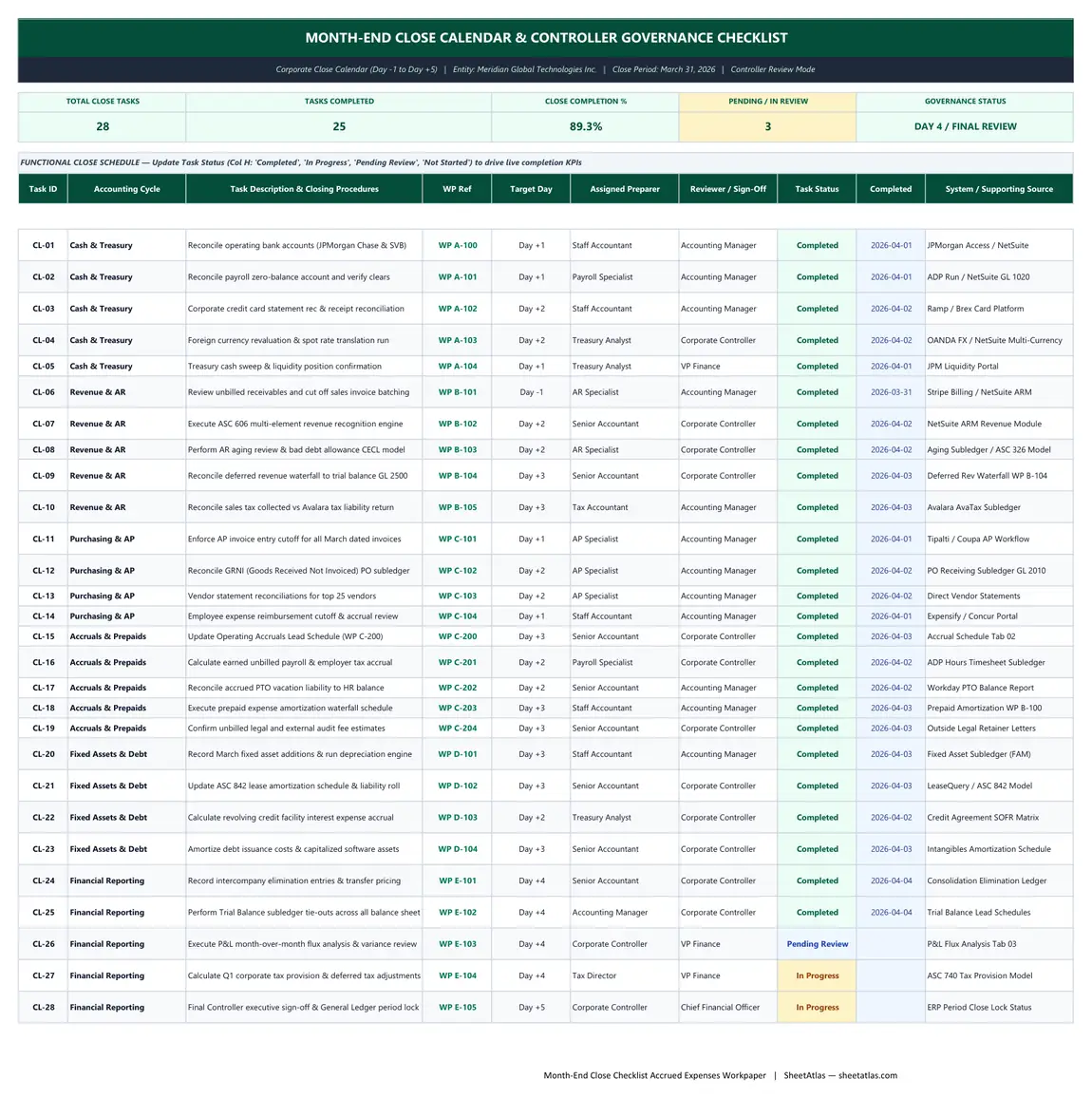
01_Month_End_Close_Checklist — Interactive Spreadsheet
| # | A | B | C | D | E | F | G | H | I | J |
|---|---|---|---|---|---|---|---|---|---|---|
| 1 | MONTH-END CLOSE CALENDAR & CONTROLLER GOVERNANCE CHECKLIST | |||||||||
| 2 | Corporate Close Calendar (Day -1 to Day +5) | Entity: Meridian Global Technologies Inc. | Close Period: March 31, 2026 | Controller Review Mode | |||||||||
| 3 | ||||||||||
| 4 | TOTAL CLOSE TASKS | TASKS COMPLETED | CLOSE COMPLETION % | PENDING / IN REVIEW | GOVERNANCE STATUS | |||||
| 5 | 28 | 25 | 89.3% | 3 | DAY 4 / FINAL REVIEW | |||||
| 6 | ||||||||||
| 7 | FUNCTIONAL CLOSE SCHEDULE — Update Task Status (Col H: 'Completed', 'In Progress', 'Pending Review', 'Not Started') to drive live completion KPIs | |||||||||
| 8 | Task ID | Accounting Cycle | Task Description & Closing Procedures | WP Ref | Target Day | Assigned Preparer | Reviewer / Sign-Off | Task Status | Completed | System / Supporting Source |
| 9 | ||||||||||
| 10 | ||||||||||
| 11 | CL-01 | Cash & Treasury | Reconcile operating bank accounts (JPMorgan Chase & SVB) | WP A-100 | Day +1 | Staff Accountant | Accounting Manager | Completed | 2026-04-01 | JPMorgan Access / NetSuite |
| 12 | CL-02 | Cash & Treasury | Reconcile payroll zero-balance account and verify clears | WP A-101 | Day +1 | Payroll Specialist | Accounting Manager | Completed | 2026-04-01 | ADP Run / NetSuite GL 1020 |
| 13 | CL-03 | Cash & Treasury | Corporate credit card statement rec & receipt reconciliation | WP A-102 | Day +2 | Staff Accountant | Accounting Manager | Completed | 2026-04-02 | Ramp / Brex Card Platform |
| 14 | CL-04 | Cash & Treasury | Foreign currency revaluation & spot rate translation run | WP A-103 | Day +2 | Treasury Analyst | Corporate Controller | Completed | 2026-04-02 | OANDA FX / NetSuite Multi-Currency |
| 15 | CL-05 | Cash & Treasury | Treasury cash sweep & liquidity position confirmation | WP A-104 | Day +1 | Treasury Analyst | VP Finance | Completed | 2026-04-01 | JPM Liquidity Portal |
| 16 | CL-06 | Revenue & AR | Review unbilled receivables and cut off sales invoice batching | WP B-101 | Day -1 | AR Specialist | Accounting Manager | Completed | 2026-03-31 | Stripe Billing / NetSuite ARM |
| 17 | CL-07 | Revenue & AR | Execute ASC 606 multi-element revenue recognition engine | WP B-102 | Day +2 | Senior Accountant | Corporate Controller | Completed | 2026-04-02 | NetSuite ARM Revenue Module |
| 18 | CL-08 | Revenue & AR | Perform AR aging review & bad debt allowance CECL model | WP B-103 | Day +2 | AR Specialist | Corporate Controller | Completed | 2026-04-02 | Aging Subledger / ASC 326 Model |
| 19 | CL-09 | Revenue & AR | Reconcile deferred revenue waterfall to trial balance GL 2500 | WP B-104 | Day +3 | Senior Accountant | Corporate Controller | Completed | 2026-04-03 | Deferred Rev Waterfall WP B-104 |
| 20 | CL-10 | Revenue & AR | Reconcile sales tax collected vs Avalara tax liability return | WP B-105 | Day +3 | Tax Accountant | Accounting Manager | Completed | 2026-04-03 | Avalara AvaTax Subledger |
| 21 | CL-11 | Purchasing & AP | Enforce AP invoice entry cutoff for all March dated invoices | WP C-101 | Day +1 | AP Specialist | Accounting Manager | Completed | 2026-04-01 | Tipalti / Coupa AP Workflow |
| 22 | CL-12 | Purchasing & AP | Reconcile GRNI (Goods Received Not Invoiced) PO subledger | WP C-102 | Day +2 | AP Specialist | Accounting Manager | Completed | 2026-04-02 | PO Receiving Subledger GL 2010 |
| 23 | CL-13 | Purchasing & AP | Vendor statement reconciliations for top 25 vendors | WP C-103 | Day +2 | AP Specialist | Accounting Manager | Completed | 2026-04-02 | Direct Vendor Statements |
| 24 | CL-14 | Purchasing & AP | Employee expense reimbursement cutoff & accrual review | WP C-104 | Day +1 | Staff Accountant | Accounting Manager | Completed | 2026-04-01 | Expensify / Concur Portal |
| 25 | CL-15 | Accruals & Prepaids | Update Operating Accruals Lead Schedule (WP C-200) | WP C-200 | Day +3 | Senior Accountant | Corporate Controller | Completed | 2026-04-03 | Accrual Schedule Tab 02 |
| 26 | CL-16 | Accruals & Prepaids | Calculate earned unbilled payroll & employer tax accrual | WP C-201 | Day +2 | Payroll Specialist | Corporate Controller | Completed | 2026-04-02 | ADP Hours Timesheet Subledger |
| 27 | CL-17 | Accruals & Prepaids | Reconcile accrued PTO vacation liability to HR balance | WP C-202 | Day +2 | Senior Accountant | Accounting Manager | Completed | 2026-04-02 | Workday PTO Balance Report |
| 28 | CL-18 | Accruals & Prepaids | Execute prepaid expense amortization waterfall schedule | WP C-203 | Day +3 | Staff Accountant | Accounting Manager | Completed | 2026-04-03 | Prepaid Amortization WP B-100 |
| 29 | CL-19 | Accruals & Prepaids | Confirm unbilled legal and external audit fee estimates | WP C-204 | Day +3 | Senior Accountant | Corporate Controller | Completed | 2026-04-03 | Outside Legal Retainer Letters |
| 30 | CL-20 | Fixed Assets & Debt | Record March fixed asset additions & run depreciation engine | WP D-101 | Day +3 | Staff Accountant | Accounting Manager | Completed | 2026-04-03 | Fixed Asset Subledger (FAM) |
| 31 | CL-21 | Fixed Assets & Debt | Update ASC 842 lease amortization schedule & liability roll | WP D-102 | Day +3 | Senior Accountant | Corporate Controller | Completed | 2026-04-03 | LeaseQuery / ASC 842 Model |
| 32 | CL-22 | Fixed Assets & Debt | Calculate revolving credit facility interest expense accrual | WP D-103 | Day +2 | Treasury Analyst | Corporate Controller | Completed | 2026-04-02 | Credit Agreement SOFR Matrix |
| 33 | CL-23 | Fixed Assets & Debt | Amortize debt issuance costs & capitalized software assets | WP D-104 | Day +3 | Senior Accountant | Corporate Controller | Completed | 2026-04-03 | Intangibles Amortization Schedule |
| 34 | CL-24 | Financial Reporting | Record intercompany elimination entries & transfer pricing | WP E-101 | Day +4 | Senior Accountant | Corporate Controller | Completed | 2026-04-04 | Consolidation Elimination Ledger |
| 35 | CL-25 | Financial Reporting | Perform Trial Balance subledger tie-outs across all balance sheet accounts | WP E-102 | Day +4 | Accounting Manager | Corporate Controller | Completed | 2026-04-04 | Trial Balance Lead Schedules |
| 36 | CL-26 | Financial Reporting | Execute P&L month-over-month flux analysis & variance review | WP E-103 | Day +4 | Corporate Controller | VP Finance | Pending Review | P&L Flux Analysis Tab 03 | |
| 37 | CL-27 | Financial Reporting | Calculate Q1 corporate tax provision & deferred tax adjustments | WP E-104 | Day +4 | Tax Director | VP Finance | In Progress | ASC 740 Tax Provision Model | |
| 38 | CL-28 | Financial Reporting | Final Controller executive sign-off & General Ledger period lock | WP E-105 | Day +5 | Corporate Controller | Chief Financial Officer | In Progress | ERP Period Close Lock Status | |
Free Instant Download
No email signup • Unlocked formulas
Built-In Excel Formulas & Calculation Logic
Unlocked native Microsoft Excel functions pre-programmed inside this workbook:
=F12+G12-H12 Calculates the ending period liability for each individual accrual sub-ledger line item by adding current-period additions (newly recognized incurred expenses) to the beginning balance and subtracting prior accrual reversals or actual vendor invoice disbursements.
=IF(ABS(L5-G4)<0.01, "TIED — BALANCED ($0.00)", "VARIANCE ALERT") Compares the sum of all schedule calculated ending accrual balances against the General Ledger Trial Balance balance (GL 2100). If the absolute discrepancy is less than one cent, it displays an audit-passed confirmation; otherwise, it triggers an immediate variance warning.
=IFERROR(COUNTIF(H11:H38, "Completed")/COUNTA(A11:A38), 0) Calculates the live percentage of close procedures completed across all accounting cycles by dividing the count of tasks marked 'Completed' by the total number of scheduled closing tasks.
=IF(OR(ABS(E25)>5000, ABS(F25)>0.1), "MATERIAL FLUX", "OK") Evaluates period-over-period operating expense fluctuations against corporate materiality criteria (greater than $5,000 absolute dollar change or greater than 10% relative variance), flagging accounts that mandate written controller commentary.
Full Workbook Print Layout Preview (.XLSX)
Overview & Industry Standard Alignment
A disciplined month-end close is the cornerstone of corporate financial integrity. However, many accounting departments struggle with fragmented closing checklists, missing audit trails, and haphazard accrual estimations that fail external audit scrutiny. When expenses incurred during a reporting period are not properly recognized before the books close, financial statements misstate liabilities, distort operating margins, and fail the fundamental matching principle required by US GAAP (ASC 340 / ASC 450) and IFRS. This Month-End Close Checklist & Accrued Expenses Rollforward Workpaper provides an integrated, audit-ready operational framework for Corporate Controllers, Accounting Managers, and Senior Accountants. Rather than treating the closing checklist and the accrual calculations as disconnected files, this template unites a structured 5-day closing calendar (Day -1 to Day +5) across six core functional cycles with a rigorous, itemized accrued expenses lead schedule (WP C-200). Every calculation is 100% dynamic, transparent, and built to withstand Big-4 audit procedures. The workbook features an automated trial balance tie-out control banner, an ERP-ready journal entry posting matrix with automatic Day 1 reversing designations, a month-over-month P&L flux analysis table with materiality thresholds, and a formal CPA audit tickmark legend.
Practical Operational Use Cases:
Corporate Month-End Close Acceleration & Day +5 Target
Establish a disciplined, day-by-day closing rhythm across Cash, Revenue, Procure-to-Pay, Accruals, Fixed Assets, and Financial Reporting to eliminate bottlenecks and reliably close the corporate general ledger within 5 business days.
Financial Statement Audit & Big-4 PBC Lead Workpapers
Provide external independent auditors with a self-contained, pre-formatted audit lead schedule (WP C-200) complete with tickmark legends, supporting subledger reconciliations, and clear documentation of estimation methodologies.
AP Cutoff Testing & Search for Unrecorded Liabilities
Systematically review post-period bank disbursements, unbilled vendor purchase orders (GRNI), and legal retainer estimates during subsequent cutoff windows to prevent understating operating expenses.
Enterprise ERP Journal Entry Batch Preparation & Reversal Automation
Generate perfectly balanced debit and credit journal entry batches ready for direct upload into NetSuite, SAP, Workday, or QuickBooks Online, complete with designated auto-reversing dates on Day 1 of the following month.
Designed For:
What’s Inside the Workbook (Tab-by-Tab Breakdown)
Worksheet 1
Corporate closing calendar and governance checklist organized across six functional cycles (Cash & Treasury, Revenue & AR, Purchasing & AP, Accruals & Prepaids, Fixed Assets & Debt, Financial Reporting). Features top KPI summary cards tracking total tasks, tasks completed, completion %, and pending reviews, with target days from Day -1 to Day +5.
Worksheet 2
CPA audit lead workpaper (WP C-200) for GL Account 2100 (Accrued Operating Expenses). Contains workpaper header controls, an automated General Ledger trial balance tie-out banner, summary KPI cards, and a detailed 14-item rollforward schedule tracking beginning balances, current additions, prior reversals, and ending liabilities.
Worksheet 3
Section 1 provides an automated, balanced month-end accrual journal entry batch with specific GL codes and descriptions, plus Day 1 reversing designations. Section 2 features a P&L month-over-month accrual flux analysis comparing prior vs. current actuals with automated materiality triggers (> $5,000 or > 10%) and controller commentary fields.
Worksheet 4
Technical accounting reference tab containing standard Big-4 and CPA audit tickmark definitions (Tick A through L, TB, PY, ✓), US GAAP ASC 450 contingency accrual criteria, expense matching principles, and standard operating procedures for AP cutoff testing.
Practitioner Tips & Best Practices
-
✓
Enforce a strict Day +1 AP invoice cutoff deadline: all vendor invoices received after this cutoff must be reviewed for accrual rather than entered into the closed accounts payable ledger.
-
✓
Designate recurring operating accruals (utilities, hosting, commissions) as auto-reversing on Day 1 of the new period to eliminate manual reversal entries and prevent double-counting when actual bills arrive.
-
✓
Establish clear dollar materiality thresholds ($2,500 to $5,000 depending on company size) so staff accountants do not waste hours estimating immaterial expenses that do not impact financial decisions.
-
✓
Always corroborate third-party estimates (such as outside legal counsel hours or audit fees) with written email confirmations or formal engagement letters before finalizing the lead schedule.
-
✓
Run the P&L flux analysis table before executive review: any expense category with a variance exceeding 10% should have an explanatory note prepared before meeting with the CFO.
Frequently Asked Questions
What is the key difference between an accrued expense and an accounts payable liability?
Accounts payable represents liabilities for goods or services for which a formal vendor invoice has already been received and entered into the accounting system. In contrast, an accrued expense represents an obligation that has been incurred during the reporting period but has not yet been billed by the vendor or paid. Accrued expenses require management to estimate the expense amount based on available evidence (such as contracts, timesheets, or receiving reports) to comply with the accrual accounting matching principle.
Why do corporate accrual journal entries typically auto-reverse on Day 1 of the next period?
Operating expense accruals are temporary estimates created solely to ensure that the current period's financial statements reflect all incurred costs. When the actual vendor invoice arrives in the subsequent period, accounts payable will record the full expense and credit AP. If the period-end accrual were not reversed, the expense would be recorded twice—once via the month-end accrual and once via the vendor invoice. Setting an automated reversal on Day 1 creates a credit balance in the expense account that is cleanly offset when the invoice is processed.
How does this workpaper verify that accrued expenses tie out to the General Ledger?
Sheet 02 includes a dedicated CPA Control Header block featuring a dynamic GL Tie-Out formula: `=IF(ABS(Schedule_Ending - TB_GL)<0.01, "TIED — BALANCED ($0.00)", "VARIANCE ALERT")`. By comparing the sum of all individual accrual rollforward lines to the Trial Balance balance in GL 2100, the schedule immediately flags any unposted entries, rounding errors, or unauthorized manual journal entries.
Which accounting standards govern accrued liabilities under US GAAP?
Under US GAAP, accrued liabilities are primarily governed by ASC 450 (Contingencies) and the expense recognition principles of ASC 340 and the FASB Conceptual Framework. An expense and liability must be recognized when it is probable that an obligation has been incurred and the amount can be reasonably estimated. If a range of loss exists and no estimate within the range is better than another, the entity must accrue the minimum amount of the range.
What is the 'Search for Unrecorded Liabilities' and how does this schedule assist?
The search for unrecorded liabilities is a standard audit procedure conducted by external CPA auditors and internal controllers to ensure all period-end obligations are recognized. Auditors examine cash disbursements, bank statements, and vendor invoices paid in the weeks following year-end (e.g., throughout January for a December 31 year-end). By maintaining an organized accrued expenses rollforward schedule with audit tickmarks and supporting documentation references, the company can readily demonstrate that all subsequent disbursements were either properly accrued at year-end or represent valid new-period expenses.
How can an accounting team achieve a 5-day fast month-end close using this checklist?
A 5-day close requires front-loading closing activities and enforcing strict cutoff deadlines. By following Sheet 01's calendar, tasks are sequenced logically: Day -1 locks preliminary billing; Day +1 completes bank reconciliations and AP cutoff; Day +2 handles inventory and prepaid amortization; Day +3 finalizes operating accruals and fixed assets; Day +4 runs consolidation and flux review; and Day +5 secures final Controller sign-off. Utilizing standardized templates eliminates ad-hoc calculations and accelerates review cycles.
Can this template be customized for different ERP systems such as NetSuite, QuickBooks, or SAP?
Yes. The workbook uses clean, universal Excel architecture without proprietary macros or hardcoded ERP dependencies. The journal entry posting matrix on Sheet 03 follows the standard General Ledger debit and credit format compatible with CSV import tools in Oracle NetSuite, SAP S/4HANA, QuickBooks Online, Xero, and Sage Intacct. You can customize account numbers and departmental segments to match your chart of accounts.