Fixed Asset Rollforward & MACRS / GAAP Depreciation Schedule Excel Template (Straight-Line & Tax Basis)
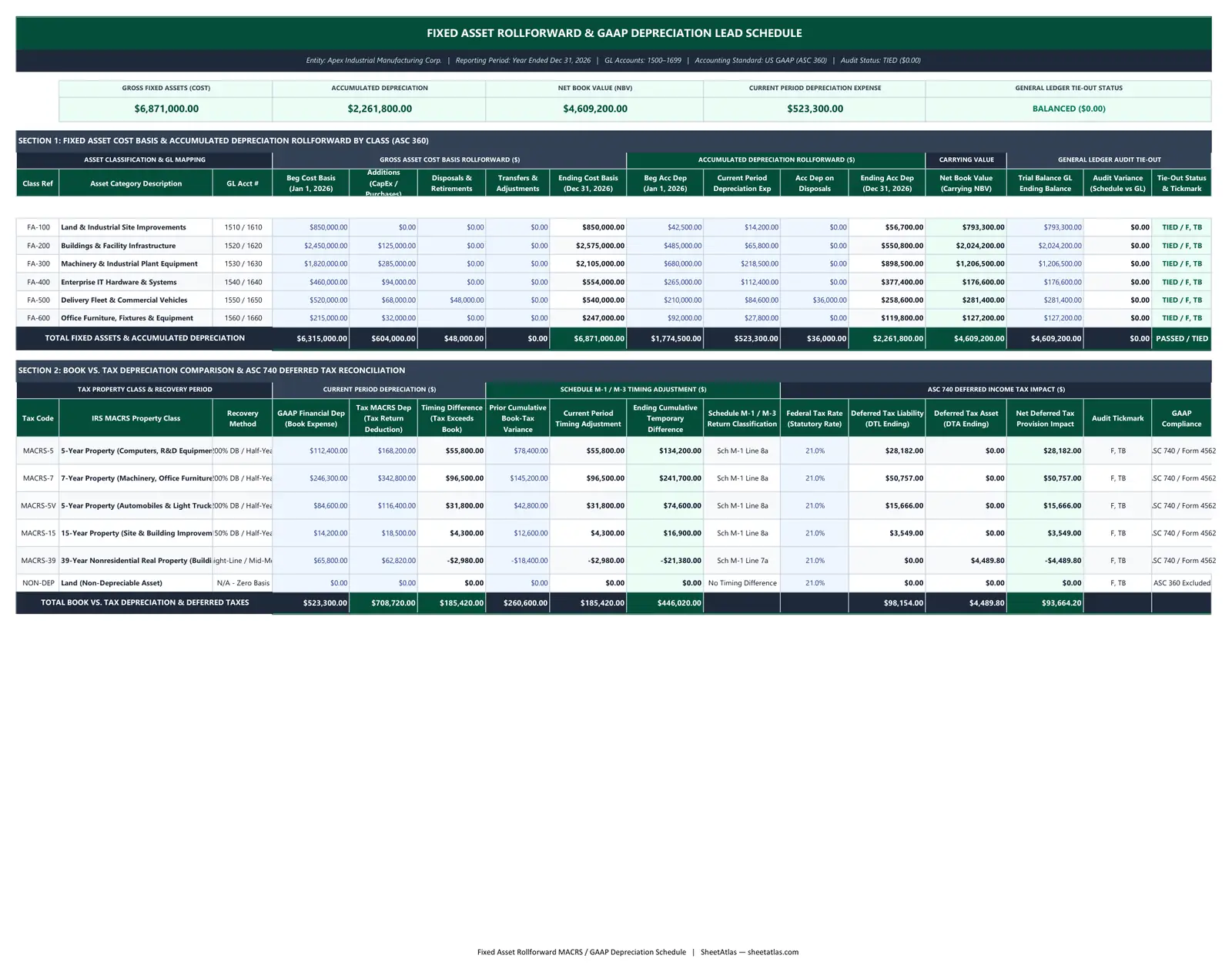
01_Asset_Rollforward_Summary — Interactive Spreadsheet
| # | A | B | C | D | E | F | G | H | I | J | K | L | M | N | O | P |
|---|---|---|---|---|---|---|---|---|---|---|---|---|---|---|---|---|
| 1 | FIXED ASSET ROLLFORWARD & GAAP DEPRECIATION LEAD SCHEDULE | |||||||||||||||
| 2 | Entity: Apex Industrial Manufacturing Corp. | Reporting Period: Year Ended Dec 31, 2026 | GL Accounts: 1500–1699 | Accounting Standard: US GAAP (ASC 360) | Audit Status: TIED ($0.00) | |||||||||||||||
| 3 | ||||||||||||||||
| 4 | GROSS FIXED ASSETS (COST) | ACCUMULATED DEPRECIATION | NET BOOK VALUE (NBV) | CURRENT PERIOD DEPRECIATION EXPENSE | GENERAL LEDGER TIE-OUT STATUS | |||||||||||
| 5 | $6,871,000.00 | $2,261,800.00 | $4,609,200.00 | $523,300.00 | BALANCED ($0.00) | |||||||||||
| 6 | ||||||||||||||||
| 7 | SECTION 1: FIXED ASSET COST BASIS & ACCUMULATED DEPRECIATION ROLLFORWARD BY CLASS (ASC 360) | |||||||||||||||
| 8 | ASSET CLASSIFICATION & GL MAPPING | GROSS ASSET COST BASIS ROLLFORWARD ($) | ACCUMULATED DEPRECIATION ROLLFORWARD ($) | CARRYING VALUE | GENERAL LEDGER AUDIT TIE-OUT | |||||||||||
| 9 | Class Ref | Asset Category Description | GL Acct # | Beg Cost Basis (Jan 1, 2026) | Additions (CapEx / Purchases) | Disposals & Retirements | Transfers & Adjustments | Ending Cost Basis (Dec 31, 2026) | Beg Acc Dep (Jan 1, 2026) | Current Period Depreciation Exp | Acc Dep on Disposals | Ending Acc Dep (Dec 31, 2026) | Net Book Value (Carrying NBV) | Trial Balance GL Ending Balance | Audit Variance (Schedule vs GL) | Tie-Out Status & Tickmark |
| 10 | ||||||||||||||||
| 11 | ||||||||||||||||
| 12 | FA-100 | Land & Industrial Site Improvements | 1510 / 1610 | $850,000.00 | $56,700.00 | $793,300.00 | $0.00 | TIED / F, TB | ||||||||
| 13 | FA-200 | Buildings & Facility Infrastructure | 1520 / 1620 | $2,575,000.00 | $550,800.00 | $2,024,200.00 | $0.00 | TIED / F, TB | ||||||||
| 14 | FA-300 | Machinery & Industrial Plant Equipment | 1530 / 1630 | $2,105,000.00 | $898,500.00 | $1,206,500.00 | $0.00 | TIED / F, TB | ||||||||
| 15 | FA-400 | Enterprise IT Hardware & Systems | 1540 / 1640 | $554,000.00 | $377,400.00 | $176,600.00 | $0.00 | TIED / F, TB | ||||||||
| 16 | FA-500 | Delivery Fleet & Commercial Vehicles | 1550 / 1650 | $540,000.00 | $258,600.00 | $281,400.00 | $0.00 | TIED / F, TB | ||||||||
| 17 | FA-600 | Office Furniture, Fixtures & Equipment | 1560 / 1660 | $247,000.00 | $119,800.00 | $127,200.00 | $0.00 | TIED / F, TB | ||||||||
| 18 | TOTAL FIXED ASSETS & ACCUMULATED DEPRECIATION | $6,315,000.00 | $604,000.00 | $48,000.00 | $0.00 | $6,871,000.00 | $1,774,500.00 | $523,300.00 | $36,000.00 | $2,261,800.00 | $4,609,200.00 | $4,609,200.00 | $0.00 | PASSED / TIED | ||
| 19 | ||||||||||||||||
| 20 | SECTION 2: BOOK VS. TAX DEPRECIATION COMPARISON & ASC 740 DEFERRED TAX RECONCILIATION | |||||||||||||||
| 21 | TAX PROPERTY CLASS & RECOVERY PERIOD | CURRENT PERIOD DEPRECIATION ($) | SCHEDULE M-1 / M-3 TIMING ADJUSTMENT ($) | ASC 740 DEFERRED INCOME TAX IMPACT ($) | ||||||||||||
| 22 | Tax Code | IRS MACRS Property Class | Recovery Method | GAAP Financial Dep (Book Expense) | Tax MACRS Dep (Tax Return Deduction) | Timing Difference (Tax Exceeds Book) | Prior Cumulative Book-Tax Variance | Current Period Timing Adjustment | Ending Cumulative Temporary Difference | Schedule M-1 / M-3 Return Classification | Federal Tax Rate (Statutory Rate) | Deferred Tax Liability (DTL Ending) | Deferred Tax Asset (DTA Ending) | Net Deferred Tax Provision Impact | Audit Tickmark | GAAP Compliance |
| 23 | MACRS-5 | 5-Year Property (Computers, R&D Equipment) | 200% DB / Half-Year | $55,800.00 | $55,800.00 | $134,200.00 | Sch M-1 Line 8a | $28,182.00 | $0.00 | $28,182.00 | F, TB | ASC 740 / Form 4562 | ||||
| 24 | MACRS-7 | 7-Year Property (Machinery, Office Furniture) | 200% DB / Half-Year | $96,500.00 | $96,500.00 | $241,700.00 | Sch M-1 Line 8a | $50,757.00 | $0.00 | $50,757.00 | F, TB | ASC 740 / Form 4562 | ||||
| 25 | MACRS-5V | 5-Year Property (Automobiles & Light Trucks) | 200% DB / Half-Year | $31,800.00 | $31,800.00 | $74,600.00 | Sch M-1 Line 8a | $15,666.00 | $0.00 | $15,666.00 | F, TB | ASC 740 / Form 4562 | ||||
| 26 | MACRS-15 | 15-Year Property (Site & Building Improvements) | 150% DB / Half-Year | $4,300.00 | $4,300.00 | $16,900.00 | Sch M-1 Line 8a | $3,549.00 | $0.00 | $3,549.00 | F, TB | ASC 740 / Form 4562 | ||||
| 27 | MACRS-39 | 39-Year Nonresidential Real Property (Buildings) | Straight-Line / Mid-Month | -$2,980.00 | -$2,980.00 | -$21,380.00 | Sch M-1 Line 7a | $0.00 | $4,489.80 | -$4,489.80 | F, TB | ASC 740 / Form 4562 | ||||
| 28 | NON-DEP | Land (Non-Depreciable Asset) | N/A - Zero Basis | $0.00 | $0.00 | $0.00 | No Timing Difference | $0.00 | $0.00 | $0.00 | F, TB | ASC 360 Excluded | ||||
| 29 | TOTAL BOOK VS. TAX DEPRECIATION & DEFERRED TAXES | $523,300.00 | $708,720.00 | $185,420.00 | $260,600.00 | $185,420.00 | $446,020.00 | $98,154.00 | $4,489.80 | $93,664.20 | ||||||
Free Instant Download
No email signup • Unlocked formulas
Built-In Excel Formulas & Calculation Logic
Unlocked native Microsoft Excel functions pre-programmed inside this workbook:
=Beginning_Cost + Additions - Disposals + Transfers Calculates ending gross fixed asset historical cost for each property class by adding current-period capital expenditures (CapEx) and deducting the gross cost basis of retired or sold assets.
=Beginning_Acc_Dep + Current_Depreciation - Acc_Dep_on_Disposals Rolls forward the contra-asset accumulated depreciation reserve under US GAAP ASC 360 by adding current-period depreciation expense and derecognizing the cumulative depreciation of disposed assets.
=Ending_Cost_Basis - Ending_Accumulated_Depreciation Computes the net balance sheet carrying value (Net Book Value) of property, plant, and equipment (PP&E) to be presented on the asset side of the corporate balance sheet.
=ROUND(Acquisition_Cost * Table_A1_Rate, 2) Applies the statutory IRS Publication 946 Table A-1 Modified Accelerated Cost Recovery System (MACRS) percentage based on asset recovery class and half-year convention to establish the tax return cost recovery deduction.
=ROUND(Tax_MACRS_Depreciation - GAAP_Book_Depreciation, 2) Determines the temporary timing difference between accelerated tax depreciation and straight-line financial accounting depreciation, establishing the Schedule M-1 / M-3 corporate tax adjustment and deferred tax liability (ASC 740).
Full Workbook Print Layout Preview (.XLSX)
Overview & Industry Standard Alignment
Managing corporate fixed assets requires strict adherence to two fundamentally different accounting frameworks: financial statement reporting under US GAAP (ASC 360) and federal income tax reporting under the Internal Revenue Code (MACRS Form 4562). While financial accounting mandates matching asset depreciation to economic utility via straight-line amortization over estimated useful life, US tax law prioritizes accelerated capital cost recovery through the Modified Accelerated Cost Recovery System (MACRS). This structural divergence creates substantial book-tax timing differences that every corporate controller, finance director, and CPA must track and reconcile at year-end. Without an integrated, audit-grade workpaper, accounting teams frequently suffer from unreconciled General Ledger variances, inaccurate deferred tax balances under ASC 740, and time-consuming audit inquiries regarding capital asset additions, retirements, and rollforwards. Engineered by senior CPAs and audit managers, this workbook unites a multi-class lead schedule rollforward, a granular 16-asset fixed asset register, automated ERP month-end closing journal entries, and an official IRS Table A-1 MACRS tax engine. Every formula remains 100% native and transparent, providing external auditors with complete mathematical visibility and zero variance against trial balance general ledger controls.
Practical Operational Use Cases:
Corporate Month-End & Year-End Close Workpaper
Establish a bulletproof audit lead schedule rolling forward gross PP&E cost, additions, disposals, accumulated depreciation, and net book value directly into financial statement balance sheet disclosures.
IRS Form 4562 & Schedule M-1 / M-3 Tax Compliance
Calculate statutory MACRS accelerated depreciation across 3, 5, 7, 15, and 39-year property classes, generating the exact temporary timing difference required for corporate tax return Schedule M-1 adjustments.
Fixed Asset Retirement & Disposal Gain/Loss Tracking
Accurately record equipment sales, trade-ins, and retirements with automatic derecognition of historical cost and accumulated depreciation, calculating realized gains or losses for general ledger posting.
External Financial Audit PBC Lead Workpaper
Present external Big-4 or regional audit teams with a pre-footed, cross-footed lead schedule featuring standard tickmarks, voucher references, and balance sheet trial balance tie-outs.
Designed For:
What’s Inside the Workbook (Tab-by-Tab Breakdown)
Worksheet 1
Worksheet 2
Worksheet 3
Worksheet 4
Practitioner Tips & Best Practices
-
✓
Leverage the IRS De Minimis Safe Harbor Election: Establish a formal written corporate capitalization policy expensing tangible property purchases under $5,000 per invoice (for companies with Applicable Financial Statements) under Treas. Reg. § 1.263(a)-1(f) to avoid unnecessary subledger clutter.
-
✓
Always Maintain Separate Book and Tax Subledgers: Never overwrite historical GAAP cost basis with Section 179 expensing or 100% bonus depreciation. Track GAAP straight-line depreciation independently from MACRS tax basis to prevent distorting corporate balance sheets and EBITDA.
-
✓
Conduct Annual Fixed Asset Physical Verifications: Ghost assets (equipment that has been scrapped, traded in, or retired without notification to accounting) distort property tax assessments and insurance premiums. Reconcile physical tag numbers against the subledger annually.
-
✓
Properly Segregate Current-Year CapEx Additions: Distinguish routine repair and maintenance expenses (immediately deductible under the tangible property repair regulations) from capital improvements that prolong asset life or adapt property to new uses.
Frequently Asked Questions
What is the difference between GAAP depreciation and tax MACRS depreciation?
GAAP depreciation under ASC 360 is designed for financial reporting transparency, allocating an asset's depreciable cost over its estimated economic useful life on a straight-line or usage basis. MACRS (Modified Accelerated Cost Recovery System) is mandated by the IRS for federal tax purposes, using statutory recovery periods (such as 5 or 7 years) and accelerated declining-balance rates to incentivize business capital investment. This difference creates temporary timing differences reconciled on IRS Schedule M-1.
How does a fixed asset rollforward work in accounting?
A fixed asset rollforward is an audit schedule that traces changes in PP&E accounts from the beginning of an accounting period to the end. The cost basis rollforward follows: Beginning Cost + Additions (CapEx) - Disposals / Retirements + Transfers = Ending Cost Basis. Simultaneously, accumulated depreciation rolls forward: Beginning Accumulated Depreciation + Current Period Depreciation Expense - Accumulated Depreciation on Disposals = Ending Accumulated Depreciation. Ending Cost minus Ending Accumulated Depreciation equals Net Book Value (NBV).
How do you calculate Straight-Line Depreciation in Excel?
You can calculate straight-line depreciation using standard arithmetic: `=(Cost - Salvage_Value) / Useful_Life_Years`, or by using Excel's built-in SLN function: `=SLN(cost, salvage, life)`. For partial-year depreciation, multiply the annual result by the fraction of the year the asset was in service (e.g., months in service divided by 12).
What is the Half-Year Convention under MACRS?
The half-year convention is the default IRS convention under MACRS for personal property (machinery, computers, equipment, vehicles). It treats all property placed in service (or disposed of) during any taxable year as placed in service (or disposed of) at the midpoint of that year. As a result, only a half-year of depreciation is allowed in the first recovery year, regardless of the exact date acquired, and the recovery schedule extends by one additional half-year at the end.
How are asset disposals and retirements recorded in this spreadsheet?
When an asset is retired or sold, the spreadsheet removes both its gross historical cost and its accumulated depreciation from the active balance sheet. The net book value (Cost minus Accumulated Depreciation) is compared against net sale proceeds. If proceeds exceed net book value, a gain is recognized (credited to Account 7200); if net book value exceeds proceeds, a loss on disposal is recognized.
How does this spreadsheet calculate ASC 740 Deferred Taxes?
When tax MACRS depreciation exceeds book GAAP depreciation, taxable income is lower than book financial income in early years. This creates a temporary difference that will reverse in later years when MACRS depreciation drops below straight-line depreciation. The spreadsheet multiplies this cumulative temporary difference by the statutory corporate tax rate (21.0%) to calculate the Deferred Tax Liability (DTL) recognized on the balance sheet under ASC 740.