3-Phase Commercial Electrical Panel Schedule Excel Template (208Y/120V & 480Y/277V NEC Load Calculator)
01_3Phase_Panel_Schedule — Interactive Spreadsheet
| # | A | B | C | D | E | F | G | H | I | J | K | L |
|---|---|---|---|---|---|---|---|---|---|---|---|---|
| 1 | 3-PHASE COMMERCIAL ELECTRICAL PANELBOARD SCHEDULE & NEC LOAD CALCULATOR | |||||||||||
| 2 | NEC Article 220 & 408 Compliant | Blue Tinted Cells = Editable User Inputs | White/Shaded Cells = Automatic Formula Calculations | |||||||||||
| 3 | ||||||||||||
| 4 | Panel Tag / Designation: | LP-1A (Main Distribution) | Line-to-Line Voltage (V): | Main Bus Rating (Amps): | ||||||||
| 5 | Location / Electric Room: | 1st Floor Electrical Closet #104 | Phase / Wire Configuration: | 3-Phase, 4-Wire Wye | Main Breaker Trip (Amps): | |||||||
| 6 | Fed From Upstream Source: | Switchboard MSB-1 (Bkr #4) | Short-Circuit AIC Rating: | 22,000 AIC Symmetrical | Enclosure / Mounting: | NEMA 1 Surface | ||||||
| 7 | ||||||||||||
| 8 | TOTAL CONNECTED LOAD (KVA) | NEC DEMAND LOAD (KVA) | 3-PHASE FEEDER CURRENT (AMPS) | MAX PHASE IMBALANCE (%) | BUS UTILIZATION & NEC STATUS | |||||||
| 9 | 0.00 kVA | 0.00 kVA | 0.0 A | 0.0% | 0 | |||||||
| 10 | ||||||||||||
| 11 | Ckt # | Circuit Load Description / Room | NEC Load Category | Poles | Breaker Trip (A) | Wire & Conduit | Phase A Load (VA) | Phase B Load (VA) | Phase C Load (VA) | Total Circuit (VA) | Line Current (A) | Breaker Load % |
| 12 | 1 | Open Office LED Troffer Lighting — Zone North | Lighting (Continuous) | 2#12, 1/2"C | 0 | 0.0 A | 0.0% | |||||
| 13 | 2 | Open Office LED Troffer Lighting — Zone South | Lighting (Continuous) | 2#12, 1/2"C | 0 | 0.0 A | 0.0% | |||||
| 14 | 3 | Corridor, Lobby & Egress Emergency Lighting | Lighting (Continuous) | 2#12, 1/2"C | 0 | 0.0 A | 0.0% | |||||
| 15 | 4 | Conference Room & Executive Suite Lighting | Lighting (Continuous) | 2#12, 1/2"C | 0 | 0.0 A | 0.0% | |||||
| 16 | 5 | General Duplex Receptacles — North Workstations | Receptacles | 2#12, 1/2"C | 0 | 0.0 A | 0.0% | |||||
| 17 | 6 | General Duplex Receptacles — South Workstations | Receptacles | 2#12, 1/2"C | 0 | 0.0 A | 0.0% | |||||
| 18 | 7 | Copy / Print Center Dedicated Receptacles | Receptacles | 2#12, 1/2"C | 0 | 0.0 A | 0.0% | |||||
| 19 | 8 | Breakroom Countertop GFCI Receptacles #1 | Receptacles | 2#12, 1/2"C | 0 | 0.0 A | 0.0% | |||||
| 20 | 9 | Breakroom Microwave & Commercial Coffee Brewer | Kitchen / Appliance | 2#12, 1/2"C | 0 | 0.0 A | 0.0% | |||||
| 21 | 10 | Breakroom Commercial Refrigerator & Ice Maker | Kitchen / Appliance | 2#12, 1/2"C | 0 | 0.0 A | 0.0% | |||||
| 22 | 11 | IT Server Rack UPS Dedicated Circuit #1 (L6-30R) | Continuous IT Load | 3#10, 3/4"C | 0 | 0.0 A | 0.0% | |||||
| 23 | 13 | IT Server Room Precision Mini-Split Cooling Unit | HVAC / Motors | 3#10, 3/4"C | 0 | 0.0 A | 0.0% | |||||
| 24 | 15 | Rooftop Packaged HVAC Unit RTU-1 (7.5 Ton 3-Phase) | HVAC / Motors | 4#8, 1"C | 0 | 0.0 A | 0.0% | |||||
| 25 | 18 | Rooftop Packaged HVAC Unit RTU-2 (5.0 Ton 3-Phase) | HVAC / Motors | 4#8, 1"C | 0 | 0.0 A | 0.0% | |||||
| 26 | 21 | Commercial Electric Water Heater EWH-1 (12 kW) | Continuous Heating | 4#8, 1"C | 0 | 0.0 A | 0.0% | |||||
| 27 | 24 | Elevator Machine Room Sump & Exhaust Fan EF-1 | HVAC / Motors | 2#12, 1/2"C | 0 | 0.0 A | 0.0% | |||||
| 28 | 25 | Exterior Building Facade & Parking Lot LED Signage | Lighting (Continuous) | 3#12, 1/2"C | 0 | 0.0 A | 0.0% | |||||
| 29 | 27 | Warehouse Roll-Up Door Operator Motor #1 | HVAC / Motors | 3#12, 1/2"C | 0 | 0.0 A | 0.0% | |||||
| 30 | 29 | EV Charging Station Level-2 Commercial Dual Port | Continuous EV Load | 3#8, 3/4"C | 0 | 0.0 A | 0.0% | |||||
| 31 | 31 | Lobby Security Turnstiles & Access Control Power | Receptacles | 2#12, 1/2"C | 0 | 0.0 A | 0.0% | |||||
| 32 | 32 | Spare Breaker — Future Tenant Improvement | Spare | — | 0 | 0.0 A | 0.0% | |||||
| 33 | 33 | Spare 3-Pole Space — Future Mechanical Expansion | Spare | — | 0 | 0.0 A | 0.0% | |||||
| 34 | TOTAL CONNECTED PANEL LOAD (VA) & AVERAGE UTILIZATION | 0 VA | 0 VA | 0 VA | 0 VA | 0.0 A | 0.0% | |||||
| 35 | PHASE CURRENT PER BUS LEG (AMPS @ LINE-TO-NEUTRAL VOLTAGE) | 0.0 A | 0.0 A | 0.0 A | 0 | |||||||
Free Instant Download
No email signup • Unlocked formulas
Built-In Excel Formulas & Calculation Logic
Unlocked native Microsoft Excel functions pre-programmed inside this workbook:
=ROUND((K33*1000)/(360.27), 1) Converts total 3-phase connected or demand load in kVA into line current (Amps) using I = (kVA × 1,000) / (√3 × V_L-L), where √3 × 208V = 360.27V for standard 208Y/120V commercial systems.
=IF(AVERAGE(D32:F32)=0, 0, (MAX(D32:F32)-MIN(D32:F32))/AVERAGE(D32:F32)) Evaluates the spread between the highest-loaded phase and lowest-loaded phase relative to the 3-phase average so electrical engineers can keep panel imbalance under the recommended 10% threshold.
=ROUND(D9*E9, 2) Applies NEC Article 220 demand factors (125% for continuous lighting and largest motor loads, 100% for first 10 kVA of receptacle load, and 50% for receptacle loads exceeding 10 kVA) to determine net feeder sizing.
=IF((J7/(200*0.8))<=1, "PASS (<80% MCB)", "OVERLOAD WARNING") Verifies that total calculated demand current remains below 80% of the main circuit breaker rating (160A continuous limit on a 200A panelboard per NEC 215.2(A)(1)).
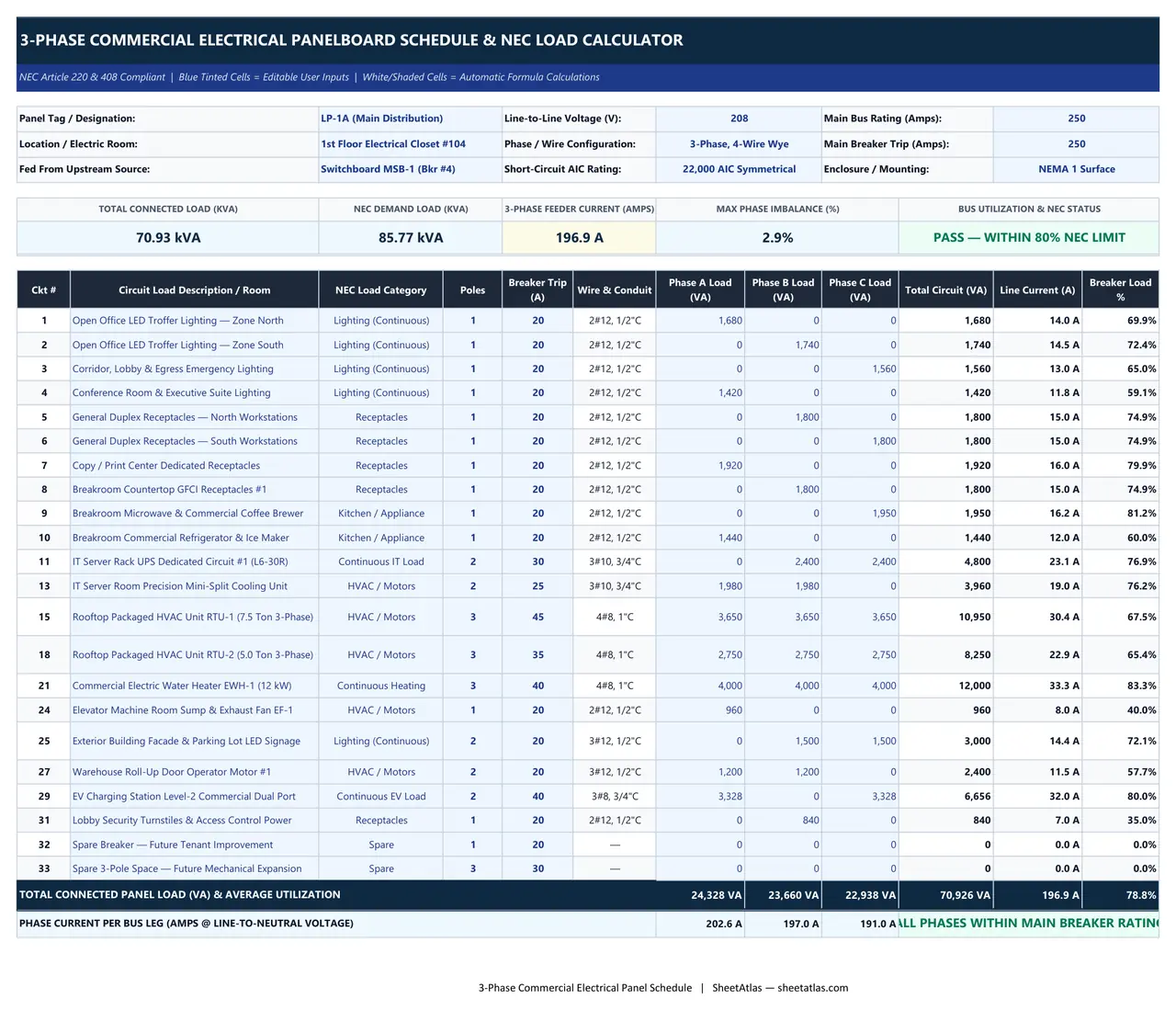
Full Workbook Print Layout Preview (.XLSX)
Overview & Industry Standard Alignment
Accurate electrical panelboard documentation is critical for commercial permitting, MEP plan review, and facility maintenance. Generic single-column spreadsheets fail to capture the alternating phase rotation (A-B-C) of commercial 3-phase busbars, forcing electrical contractors and engineers to manually sum Phase A, Phase B, and Phase C loads by hand. This 3-Phase Commercial Electrical Panel Schedule Excel Template (.xlsx) mirrors standard MEP engineering CAD schedules with odd circuits (1 through 41) on the left and even circuits (2 through 42) on the right, flanking a central Phase A / Phase B / Phase C Volt-Ampere load matrix. As you enter circuit breaker trip ratings, pole counts (1P, 2P, or 3P), and branch loads, the workbook dynamically totals connected kVA per phase, calculates phase imbalance percentages, and feeds the data into an interconnected NEC Article 220 demand calculation sheet.
Practical Operational Use Cases:
Commercial Tenant Improvement (TI) Permitting
Generate clean, building-department-ready 42-circuit panel schedules for office buildouts, retail storefronts, and restaurant electrical submittals.
Phase Balancing & Busbar Load Audits
Identify overloaded phases on existing 208Y/120V or 480Y/277V distribution panels and simulate circuit swaps to bring phase imbalance below 5%.
Service & Feeder Sizing per NEC Article 220
Apply statutory NEC demand factors for continuous lighting, commercial receptacles, HVAC compressors, and kitchen equipment to size feeders and transformers.
Facility Panel Directory Door Cards
Print a crisp, single-page US Letter or A4 Landscape circuit directory to mount inside electrical closet panel doors for OSHA and NEC 408.4 compliance.
Designed For:
What’s Inside the Workbook (Tab-by-Tab Breakdown)
01_3Phase_Panel_Schedule (42-Circuit Odd/Even Schedule & KPI Header)
Complete 42-pole commercial panelboard schedule featuring enclosure metadata (Voltage, Main Bus Amps, AIC Rating, Mounting, Fed From), 4 live KPI summary cards (Total Connected kVA, Net NEC Demand kVA, Calculated Feeder Amps, and Phase Imbalance %), and phase-by-phase VA totals.
02_NEC_220_Demand_Calc (Feeder & Service Demand Factor Worksheet)
Structured NEC Article 220 engineering calculation sheet separating Continuous Lighting (125%), Non-Continuous Receptacles (first 10 kVA at 100%, remainder at 50% per NEC 220.44), HVAC/Motors, and Continuous Equipment.
03_NEC_Wire_Ampacity_Ref (NEC Table 310.16 & Conduit Sizing Reference)
Built-in engineering lookup table detailing Copper (THHN/THWN-2) and Aluminum (XHHW-2) conductor ampacities at 60°C, 75°C, and 90°C terminals, Equipment Grounding Conductor (EGC) sizes per NEC 250.122, and EMT conduit trade sizes.
Practitioner Tips & Best Practices
-
✓
Keep Phase Imbalance Under 10%: When assigning single-pole 120V or 277V branch circuits, distribute high-draw loads evenly across rows mapped to Phase A (Ckts 1,2 / 7,8), Phase B (Ckts 3,4 / 9,10), and Phase C (Ckts 5,6 / 11,12) to minimize neutral return current and transformer heating.
-
✓
Account for the 125% Continuous Load Rule (NEC 210.20): Any commercial lighting or HVAC load expected to run continuously for 3 hours or more must be sized at 125% of the continuous load. Use Tab 02 to verify that your main breaker and feeder conductors satisfy this requirement.
-
✓
Use 75°C Terminal Ampacity Column for Standard Breakers: Even when pulling 90°C THHN/THWN-2 wire, most commercial circuit breakers and panelboard lugs are rated for 75°C terminations per NEC 110.14(C). Always size your feeder wire using the 75°C column in Tab 03.
-
✓
Document Spare and Space Poles Clearly: Distinguish between 'SPARE' (an installed circuit breaker with no load wired) and 'SPACE' (an empty busbar slot with filler plate) so field electricians know exactly how many physical breakers exist in the enclosure.
Frequently Asked Questions
How do you calculate 3-phase Amps from kVA in a 208Y/120V panel schedule?
To convert 3-phase kVA to line current in Amps, multiply total kVA by 1,000 to get Volt-Amperes (VA), then divide by (√3 × Line-to-Line Voltage). For a 208Y/120V 3-phase system, √3 × 208V equals 360.27, so Amps = Total VA / 360.27.
How does phase rotation work on a standard 42-circuit 3-phase panelboard?
In a standard commercial 3-phase panelboard, busbars alternate vertically down the enclosure: Circuits 1 & 2 connect to Phase A, Circuits 3 & 4 connect to Phase B, Circuits 5 & 6 connect to Phase C, and the A-B-C sequence repeats every six circuit positions through Circuits 41 & 42.
Can I use this Excel panel schedule for 480Y/277V commercial lighting and HVAC panels?
Yes. Both 208Y/120V and 480Y/277V Wye panelboards use the exact same 3-phase 4-wire odd/even busbar geometry. Simply update the voltage label in the header and adjust the √3 × 480V (831.38) divisor in the Amps formula cell if modeling a 480Y/277V distribution board.
What is an acceptable phase imbalance percentage on a 3-phase electrical panel?
Best engineering practice is to keep connected load imbalance across Phase A, Phase B, and Phase C under 10% (and ideally under 5%). Excessive phase imbalance increases neutral conductor current, causes voltage unbalance on 3-phase motors, and reduces available panel capacity.
When can I apply the NEC 220.44 50% demand factor for commercial receptacles?
Under NEC Section 220.44, non-dwelling general-purpose receptacle loads calculated at 180 VA per strap may be totaled together: the first 10 kVA (10,000 VA) is taken at 100% demand, and all receptacle load exceeding 10 kVA is calculated at a 50% demand factor.
Are the formulas in this electrical panel schedule unlocked and macro-free?
Yes. The entire .xlsx workbook uses 100% standard, unlocked Microsoft Excel formulas (SUM, AVERAGE, MAX, MIN, ROUND, IF) with zero VBA macros, making it completely safe for corporate networks, Google Sheets, and municipal permit submissions.