Painting Contractor Takeoff & Bid Calculator Excel Spreadsheet (Interior/Exterior Sq Ft, Gallons & Labor Production)
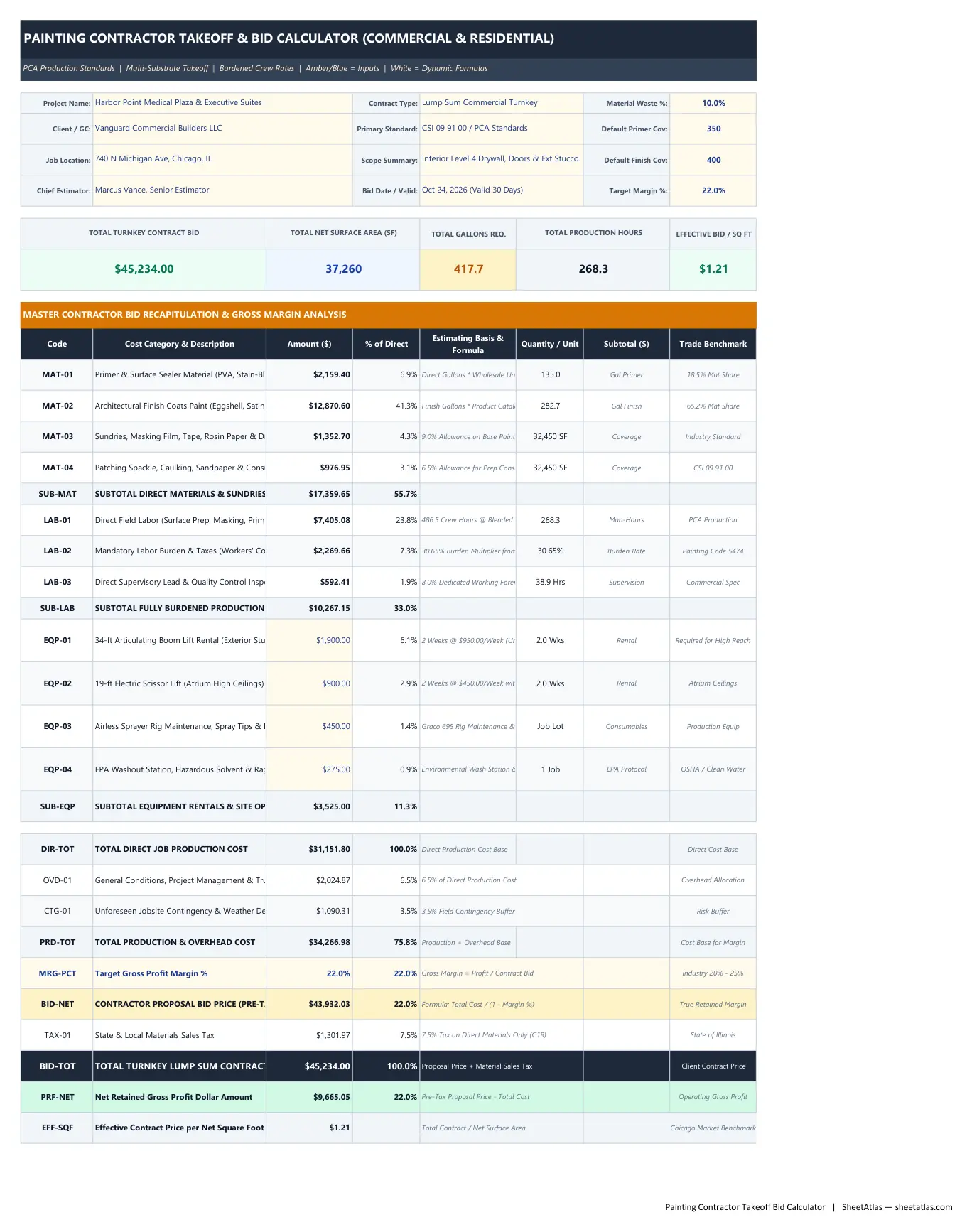
01_Executive_Bid_Summary — Interactive Spreadsheet
| # | A | B | C | D | E | F | G | H |
|---|---|---|---|---|---|---|---|---|
| 1 | PAINTING CONTRACTOR TAKEOFF & BID CALCULATOR (COMMERCIAL & RESIDENTIAL) | |||||||
| 2 | PCA Production Standards | Multi-Substrate Takeoff | Burdened Crew Rates | Amber/Blue = Inputs | White = Dynamic Formulas | |||||||
| 3 | ||||||||
| 4 | Project Name: | Harbor Point Medical Plaza & Executive Suites | Contract Type: | Lump Sum Commercial Turnkey | Material Waste %: | |||
| 5 | Client / GC: | Vanguard Commercial Builders LLC | Primary Standard: | CSI 09 91 00 / PCA Standards | Default Primer Cov: | |||
| 6 | Job Location: | 740 N Michigan Ave, Chicago, IL | Scope Summary: | Interior Level 4 Drywall, Doors & Ext Stucco | Default Finish Cov: | |||
| 7 | Chief Estimator: | Marcus Vance, Senior Estimator | Bid Date / Valid: | Oct 24, 2026 (Valid 30 Days) | Target Margin %: | |||
| 8 | ||||||||
| 9 | TOTAL TURNKEY CONTRACT BID | TOTAL NET SURFACE AREA (SF) | TOTAL GALLONS REQ. | TOTAL PRODUCTION HOURS | EFFECTIVE BID / SQ FT | |||
| 10 | $45,234.00 | 37,260 | 417.7 | 268.3 | $1.21 | |||
| 11 | ||||||||
| 12 | ||||||||
| 13 | MASTER CONTRACTOR BID RECAPITULATION & GROSS MARGIN ANALYSIS | |||||||
| 14 | Code | Cost Category & Description | Amount ($) | % of Direct | Estimating Basis & Formula | Quantity / Unit | Subtotal ($) | Trade Benchmark |
| 15 | MAT-01 | Primer & Surface Sealer Material (PVA, Stain-Block & DTM) | $2,159.40 | 6.9% | Direct Gallons * Wholesale Unit Rate | 135.0 | Gal Primer | 18.5% Mat Share |
| 16 | MAT-02 | Architectural Finish Coats Paint (Eggshell, Satin, Enamel & Ext) | $12,870.60 | 41.3% | Finish Gallons * Product Catalog Rates | 282.7 | Gal Finish | 65.2% Mat Share |
| 17 | MAT-03 | Sundries, Masking Film, Tape, Rosin Paper & Drop Cloths | $1,352.70 | 4.3% | 9.0% Allowance on Base Paint Cost | 32,450 SF | Coverage | Industry Standard |
| 18 | MAT-04 | Patching Spackle, Caulking, Sandpaper & Consumables | $976.95 | 3.1% | 6.5% Allowance for Prep Consumables | 32,450 SF | Coverage | CSI 09 91 00 |
| 19 | SUB-MAT | SUBTOTAL DIRECT MATERIALS & SUNDRIES | $17,359.65 | 55.7% | ||||
| 20 | LAB-01 | Direct Field Labor (Surface Prep, Masking, Priming & 2 Coats) | $7,405.08 | 23.8% | 486.5 Crew Hours @ Blended $28.00/hr Base | 268.3 | Man-Hours | PCA Production |
| 21 | LAB-02 | Mandatory Labor Burden & Taxes (Workers' Comp, FICA, SUTA, GL) | $2,269.66 | 7.3% | 30.65% Burden Multiplier from Tab 03 | 30.65% | Burden Rate | Painting Code 5474 |
| 22 | LAB-03 | Direct Supervisory Lead & Quality Control Inspection Allowance | $592.41 | 1.9% | 8.0% Dedicated Working Foreman Oversight | 38.9 Hrs | Supervision | Commercial Spec |
| 23 | SUB-LAB | SUBTOTAL FULLY BURDENED PRODUCTION LABOR | $10,267.15 | 33.0% | ||||
| 24 | EQP-01 | 34-ft Articulating Boom Lift Rental (Exterior Stucco) | 6.1% | 2 Weeks @ $950.00/Week (United Rentals / Sunbelt) | 2.0 Wks | Rental | Required for High Reach | |
| 25 | EQP-02 | 19-ft Electric Scissor Lift (Atrium High Ceilings) | 2.9% | 2 Weeks @ $450.00/Week with Non-Marking Tires | 2.0 Wks | Rental | Atrium Ceilings | |
| 26 | EQP-03 | Airless Sprayer Rig Maintenance, Spray Tips & HEPA Sanding | 1.4% | Graco 695 Rig Maintenance & 517/515 Reversible Tips | Job Lot | Consumables | Production Equip | |
| 27 | EQP-04 | EPA Washout Station, Hazardous Solvent & Rags Disposal | 0.9% | Environmental Wash Station & Disposal Permit | 1 Job | EPA Protocol | OSHA / Clean Water | |
| 28 | SUB-EQP | SUBTOTAL EQUIPMENT RENTALS & SITE OPERATIONS | $3,525.00 | 11.3% | ||||
| 29 | ||||||||
| 30 | DIR-TOT | TOTAL DIRECT JOB PRODUCTION COST | $31,151.80 | 100.0% | Direct Production Cost Base | Direct Cost Base | ||
| 31 | OVD-01 | General Conditions, Project Management & Truck Mobilization | $2,024.87 | 6.5% | 6.5% of Direct Production Cost | Overhead Allocation | ||
| 32 | CTG-01 | Unforeseen Jobsite Contingency & Weather Delay Allowance | $1,090.31 | 3.5% | 3.5% Field Contingency Buffer | Risk Buffer | ||
| 33 | PRD-TOT | TOTAL PRODUCTION & OVERHEAD COST | $34,266.98 | 75.8% | Production + Overhead Base | Cost Base for Margin | ||
| 34 | MRG-PCT | Target Gross Profit Margin % | Gross Margin = Profit / Contract Bid | Industry 20% - 25% | ||||
| 35 | BID-NET | CONTRACTOR PROPOSAL BID PRICE (PRE-TAX) | $43,932.03 | 22.0% | Formula: Total Cost / (1 - Margin %) | True Retained Margin | ||
| 36 | TAX-01 | State & Local Materials Sales Tax | $1,301.97 | 7.5% | 7.5% Tax on Direct Materials Only (C19) | State of Illinois | ||
| 37 | BID-TOT | TOTAL TURNKEY LUMP SUM CONTRACT PRICE | $45,234.00 | 100.0% | Proposal Price + Material Sales Tax | Client Contract Price | ||
| 38 | PRF-NET | Net Retained Gross Profit Dollar Amount | $9,665.05 | 22.0% | Pre-Tax Proposal Price - Total Cost | Operating Gross Profit | ||
| 39 | EFF-SQF | Effective Contract Price per Net Square Foot | $1.21 | Total Contract / Net Surface Area | Chicago Market Benchmark | |||
Free Instant Download
No email signup • Unlocked formulas
Built-In Excel Formulas & Calculation Logic
Unlocked native Microsoft Excel functions pre-programmed inside this workbook:
=ROUNDUP((G10*J10/K10)*(1+L10), 1) Calculates the total required gallons for any architectural coating by multiplying net surface square footage by the number of specified coats, dividing by practical coverage (SF per gallon), and applying the trade waste allowance (typically 8% to 15% for overspray and roller absorption). The ROUNDUP function prevents running out of paint on the jobsite.
=ROUNDUP(G10/O10, 1) Determines required direct field man-hours by dividing net surface square footage by the Painting Contractors Association (PCA) benchmark production rate (SF per man-hour) for that specific substrate, application method (brush, roller, airless spray, or spray and backroll), and prep condition.
=ROUND(C6*(1+E6), 2) Calculates the true hourly cost of field labor by compounding base wages with mandatory statutory burden: FICA/Medicare (7.65%), FUTA/SUTA unemployment (4.40%), Workers' Compensation Insurance (Painting Code 5474 at 10.50%), General Liability (3.60%), and paid time off (4.50%), totaling a 30.65% labor burden multiplier.
=ROUND(C34/(1-C35), 2) Computes the pre-tax contractor bid price by dividing total production cost (direct materials, fully burdened labor, equipment rentals, overhead, and contingency) by one minus the target gross margin percentage. This guarantees retained gross profit rather than diluted markup math.
=ROUND(1604*Solids_Volume_Pct/Target_DFT, 0) Calculates theoretical paint coverage per gallon based on coating volume solids percentage and dry film thickness (DFT in mils), where 1 gallon spreading over 1,604 square feet yields exactly 1.0 mil wet film thickness.
Full Workbook Print Layout Preview (.XLSX)
Overview & Industry Standard Alignment
Accurate estimating in commercial and residential painting requires far more sophistication than applying a generic flat rate per square foot. Every substrate—whether newly hung Level 4 drywall, porous exterior stucco, CMU block, architectural wood millwork, or structural steel decking—exhibits drastically different absorption rates, dry film thickness requirements, and crew application speeds. Estimators who rely on basic guesswork routinely underestimate surface prep, overspray loss factors, masking supplies, and high-reach aerial lift rentals, quietly destroying project profitability. This Painting Contractor Takeoff & Bid Calculator Excel template provides a battle-tested, contractor-grade estimating framework designed by industry practitioners. It organizes multi-substrate takeoffs by CSI Division 09 91 00, separates primer sealing coats from intermediate and finish coats, and integrates official Painting Contractors Association (PCA) production rates across standard application techniques (spray, cut-and-roll, spray-and-backroll, and fine-finish detail brush). Beyond material takeoff geometry, the workbook features an exhaustive labor burden calculator tailored to Painting Classification Code 5474, integrating Workers' Compensation, payroll taxes, liability insurance, and paid time off. By linking direct production costs to general conditions, mobilization, field contingencies, and true gross margin mathematics (Cost / [1 - Margin %]), this workbook ensures that every submitted proposal is commercially defensible, competitive, and highly profitable.
Practical Operational Use Cases:
Commercial Interior Fit-Outs & Tenant Improvement Bids
Quantify drywall partitions, suspended acoustic gypsum ceilings, hollow metal door frames, wood baseboards, and accent walls for commercial offices, retail plazas, and medical clinics.
Exterior Stucco, EIFS & Multi-Family Repaint Projects
Calculate elastomeric masonry coating requirements, pressure washing prep hours, articulating boom lift rentals, and window masking film for large-scale multi-family apartment communities.
High-End Residential Architectural Painting Proposals
Build itemized proposals for multi-story residential custom homes detailing crown molding linear footage, enameled cabinet packages, stain-blocking primers, and Level 5 smooth-wall finishes.
Supply House Purchase Orders & Material Order Management
Generate exact commercial supply house purchase orders for 5-gallon paint buckets, PVA primers, 3M safe-release masking tape cases, Hand-Masker plastic rolls, and caulking tubes.
Designed For:
What’s Inside the Workbook (Tab-by-Tab Breakdown)
01_Executive_Bid_Summary (Master Bid Recapitulation & Gross Margin Analysis)
Houses project metadata, 5 prominent executive KPI cards, itemized cost recapitulation (Direct Materials, Burdened Labor, Equipment Rentals, General Conditions, Contingency), target gross margin slider (22%), material sales tax calculation, and turnkey client proposal price.
02_Detailed_Area_Takeoff (Granular 16-Item Room & Substrate Measurement Schedule)
Granular takeoff table tracking item codes, room descriptions, coating specifications, application methods, gross measured areas, opening deductions, primer/finish coat counts, practical coverage yields, waste allowances, labor hours, and line-item direct costs.
03_Labor_Burden_and_Rates (Statutory Wage Burden Matrix & Wholesale Coating Catalog)
Includes a 4-tier crew wage schedule with Workers' Comp Code 5474, FICA, FUTA/SUTA, and GL insurance; composite blended crew wage calculator; and a 14-product commercial coating catalog with wholesale rates and MPI standards.
04_PCA_Coverage_and_Ref (PCA Production Standards, Coverage Equations & Estimating Rules)
Reference schedule detailing official PCA square-foot-per-man-hour production benchmarks, the <100 SF window deduction rule, DFT vs WFT mil thickness equations, and environmental wash station protocols.
Practitioner Tips & Best Practices
-
✓
Apply the PCA '<100 Sq Ft' Opening Deduction Standard: Under Painting Contractors Association guidelines, never deduct window or door openings smaller than 100 square feet. The labor required to mask, caulk, cut-in, and trim around small openings equals or exceeds the paint saved. Only deduct large storefront windows, garage bays, or blank masonry voids exceeding 100 sq ft.
-
✓
Factor in 15%–20% Overspray Loss on Exterior Spray Applications: While interior roller application experiences only 5%–8% spatter loss, exterior airless spraying on textured stucco or siding loses 15% to 25% of coating volume to atomization and ambient breeze. Always increase material waste to 15% on exterior spray elevations to avoid running short of custom-tinted batches.
-
✓
Use Wet Film Thickness (WFT) Gauges to Prevent Premature Failure: Elastomeric masonry and high-performance industrial coatings require strict dry film thickness (e.g., 5.0 mils DFT). Calculate wet film thickness using WFT = DFT / Solids by Volume. Instruct spray crews to verify mil thickness with a notched metal comb gauge during application to prevent pinholing and water infiltration.
-
✓
Calculate Bid Price Using Gross Margin, Never Simple Markup: To achieve a true 22% gross profit margin on a $35,000 production cost, divide by (1 - 0.22) = 0.78, yielding a contract price of $44,871.79 ($9,871.79 profit). Applying a 22% markup directly to cost yields only $42,700 ($7,700 profit, or an actual margin of 18.0%), quietly leaking over $2,100 in net profit.
Frequently Asked Questions
How do you calculate paint gallons needed for a room in Excel?
In Excel, calculate paint gallons by multiplying the room's net paintable square footage (gross wall area minus unpainted openings exceeding 100 SF) by the number of finish coats, dividing by the paint's practical coverage rate (typically 350 to 400 sq ft per gallon), and applying a waste allowance (10%). Wrap the formula in =ROUNDUP(..., 1) to determine whole gallon purchase requirements: =ROUNDUP((Net_SqFt * Coats / Coverage) * (1 + Waste_Pct), 1).
What is the PCA standard rule for window and door deductions in painting estimates?
According to official Painting Contractors Association (PCA) estimating standards, openings smaller than 100 square feet (such as standard 3'x7' doors or residential windows) should NOT be deducted from gross wall square footage. The time and labor required to mask, tape, spackle, and cut-in around the perimeter of small openings equals or exceeds the nominal cost of paint saved.
What is the difference between markup and gross profit margin for painting contractors?
Markup is the percentage added directly onto production cost (Price = Cost * [1 + Markup %]), whereas Gross Margin is the percentage of total contract price that remains as profit (Price = Cost / [1 - Margin %]). If a painting project costs $10,000 to produce, adding a 25% markup yields $12,500 ($2,500 profit, or a 20% margin). To actually retain a 25% gross profit margin, the bid must be $10,000 / (1 - 0.25) = $13,333.33 ($3,333.33 profit).
What is Workers' Compensation Classification Code 5474 for painting?
Code 5474 is the standard National Council on Compensation Insurance (NCCI) classification for painting, decorating, and paperhanging operations. Because painting involves ladder, scaffolding, and elevated work, insurance rates typically range from 8% to 14% of gross payroll, making it a critical component of mandatory labor burden that must be factored into crew hourly billing rates.
How many square feet can a painter paint per hour according to PCA standards?
PCA production benchmarks vary by substrate and method: spraying and backrolling new commercial drywall walls achieves 200 to 250 sq ft per man-hour; cutting-in and rolling residential walls with trim achieves 125 to 160 sq ft per man-hour; brush application on wood baseboards achieves 60 to 85 sq ft (approx. 40 to 60 linear feet) per hour; and spraying commercial dryfall on open ceilings achieves 250 to 300 sq ft per hour.
How do you convert Wet Film Thickness (WFT) to Dry Film Thickness (DFT)?
The relationship between wet film thickness and dry film thickness depends on the coating's volume solids percentage: DFT = WFT * (Solids by Volume % / 100), and conversely, WFT = DFT / (Solids by Volume % / 100). For example, if a high-build elastomeric coating has 50% solids by volume and the specification calls for 10 mils DFT, the painter must apply 20 mils WFT wet on the wall.