200-Amp Single-Phase Residential Panel Schedule Excel Template (120/240V NEC Article 220 Load Calculation)
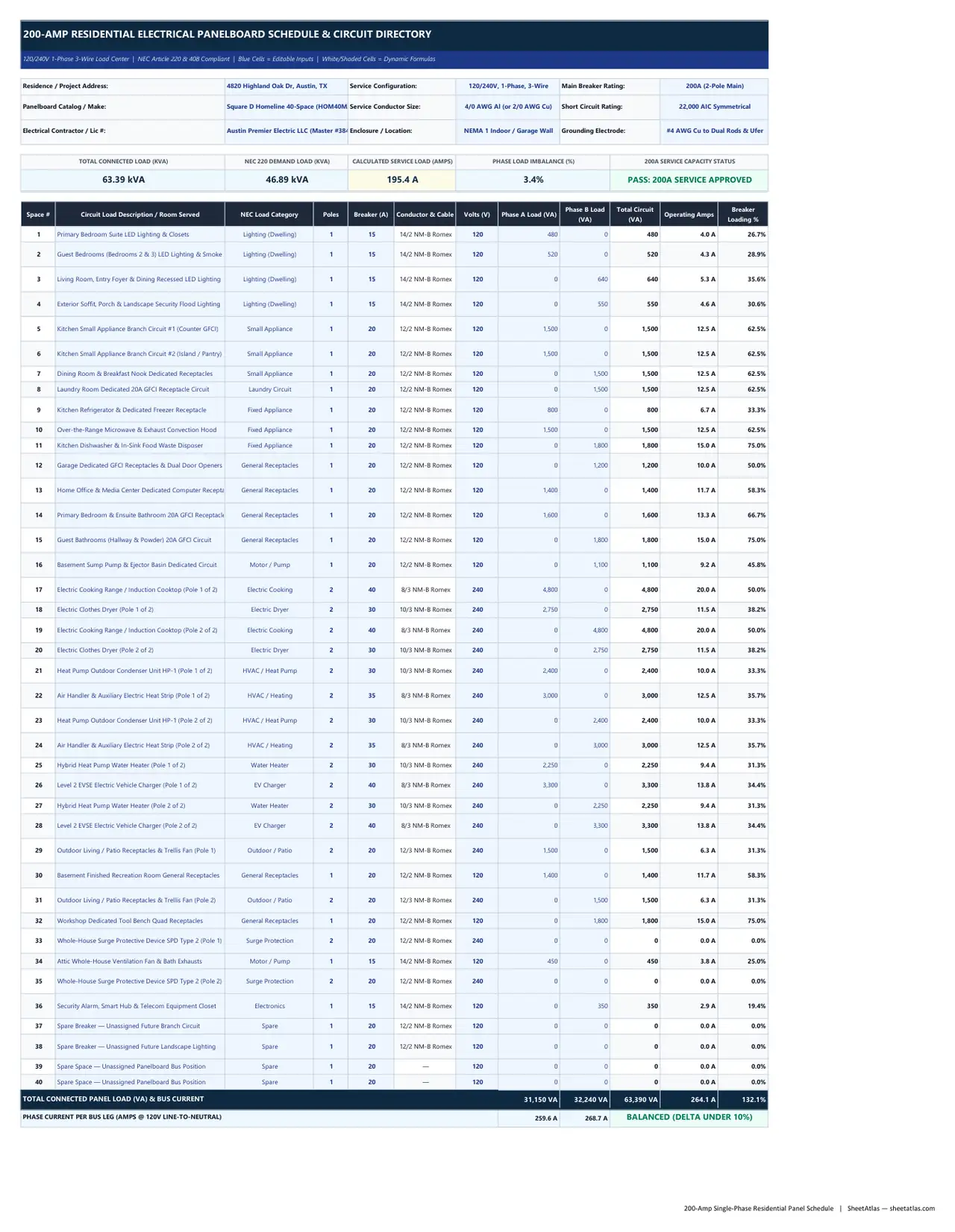
01_200A_Panel_Schedule — Interactive Spreadsheet
| # | A | B | C | D | E | F | G | H | I | J | K | L |
|---|---|---|---|---|---|---|---|---|---|---|---|---|
| 1 | 200-AMP RESIDENTIAL ELECTRICAL PANELBOARD SCHEDULE & CIRCUIT DIRECTORY | |||||||||||
| 2 | 120/240V 1-Phase 3-Wire Load Center | NEC Article 220 & 408 Compliant | Blue Cells = Editable Inputs | White/Shaded Cells = Dynamic Formulas | |||||||||||
| 3 | ||||||||||||
| 4 | Residence / Project Address: | 4820 Highland Oak Dr, Austin, TX | Service Configuration: | 120/240V, 1-Phase, 3-Wire | Main Breaker Rating: | 200A (2-Pole Main) | ||||||
| 5 | Panelboard Catalog / Make: | Square D Homeline 40-Space (HOM40M200C) | Service Conductor Size: | 4/0 AWG Al (or 2/0 AWG Cu) | Short Circuit Rating: | 22,000 AIC Symmetrical | ||||||
| 6 | Electrical Contractor / Lic #: | Austin Premier Electric LLC (Master #38491) | Enclosure / Location: | NEMA 1 Indoor / Garage Wall | Grounding Electrode: | #4 AWG Cu to Dual Rods & Ufer | ||||||
| 7 | ||||||||||||
| 8 | TOTAL CONNECTED LOAD (KVA) | NEC 220 DEMAND LOAD (KVA) | CALCULATED SERVICE LOAD (AMPS) | PHASE LOAD IMBALANCE (%) | 200A SERVICE CAPACITY STATUS | |||||||
| 9 | 63.39 kVA | 46.89 kVA | 195.4 A | 3.4% | PASS: 200A SERVICE APPROVED | |||||||
| 10 | ||||||||||||
| 11 | Space # | Circuit Load Description / Room Served | NEC Load Category | Poles | Breaker (A) | Conductor & Cable | Volts (V) | Phase A Load (VA) | Phase B Load (VA) | Total Circuit (VA) | Operating Amps | Breaker Loading % |
| 12 | 1 | Primary Bedroom Suite LED Lighting & Closets | Lighting (Dwelling) | 14/2 NM-B Romex | 480 | 4.0 A | 26.7% | |||||
| 13 | 2 | Guest Bedrooms (Bedrooms 2 & 3) LED Lighting & Smoke Alarms | Lighting (Dwelling) | 14/2 NM-B Romex | 520 | 4.3 A | 28.9% | |||||
| 14 | 3 | Living Room, Entry Foyer & Dining Recessed LED Lighting | Lighting (Dwelling) | 14/2 NM-B Romex | 640 | 5.3 A | 35.6% | |||||
| 15 | 4 | Exterior Soffit, Porch & Landscape Security Flood Lighting | Lighting (Dwelling) | 14/2 NM-B Romex | 550 | 4.6 A | 30.6% | |||||
| 16 | 5 | Kitchen Small Appliance Branch Circuit #1 (Counter GFCI) | Small Appliance | 12/2 NM-B Romex | 1,500 | 12.5 A | 62.5% | |||||
| 17 | 6 | Kitchen Small Appliance Branch Circuit #2 (Island / Pantry) | Small Appliance | 12/2 NM-B Romex | 1,500 | 12.5 A | 62.5% | |||||
| 18 | 7 | Dining Room & Breakfast Nook Dedicated Receptacles | Small Appliance | 12/2 NM-B Romex | 1,500 | 12.5 A | 62.5% | |||||
| 19 | 8 | Laundry Room Dedicated 20A GFCI Receptacle Circuit | Laundry Circuit | 12/2 NM-B Romex | 1,500 | 12.5 A | 62.5% | |||||
| 20 | 9 | Kitchen Refrigerator & Dedicated Freezer Receptacle | Fixed Appliance | 12/2 NM-B Romex | 800 | 6.7 A | 33.3% | |||||
| 21 | 10 | Over-the-Range Microwave & Exhaust Convection Hood | Fixed Appliance | 12/2 NM-B Romex | 1,500 | 12.5 A | 62.5% | |||||
| 22 | 11 | Kitchen Dishwasher & In-Sink Food Waste Disposer | Fixed Appliance | 12/2 NM-B Romex | 1,800 | 15.0 A | 75.0% | |||||
| 23 | 12 | Garage Dedicated GFCI Receptacles & Dual Door Openers | General Receptacles | 12/2 NM-B Romex | 1,200 | 10.0 A | 50.0% | |||||
| 24 | 13 | Home Office & Media Center Dedicated Computer Receptacles | General Receptacles | 12/2 NM-B Romex | 1,400 | 11.7 A | 58.3% | |||||
| 25 | 14 | Primary Bedroom & Ensuite Bathroom 20A GFCI Receptacles | General Receptacles | 12/2 NM-B Romex | 1,600 | 13.3 A | 66.7% | |||||
| 26 | 15 | Guest Bathrooms (Hallway & Powder) 20A GFCI Circuit | General Receptacles | 12/2 NM-B Romex | 1,800 | 15.0 A | 75.0% | |||||
| 27 | 16 | Basement Sump Pump & Ejector Basin Dedicated Circuit | Motor / Pump | 12/2 NM-B Romex | 1,100 | 9.2 A | 45.8% | |||||
| 28 | 17 | Electric Cooking Range / Induction Cooktop (Pole 1 of 2) | Electric Cooking | 8/3 NM-B Romex | 4,800 | 20.0 A | 50.0% | |||||
| 29 | 18 | Electric Clothes Dryer (Pole 1 of 2) | Electric Dryer | 10/3 NM-B Romex | 2,750 | 11.5 A | 38.2% | |||||
| 30 | 19 | Electric Cooking Range / Induction Cooktop (Pole 2 of 2) | Electric Cooking | 8/3 NM-B Romex | 4,800 | 20.0 A | 50.0% | |||||
| 31 | 20 | Electric Clothes Dryer (Pole 2 of 2) | Electric Dryer | 10/3 NM-B Romex | 2,750 | 11.5 A | 38.2% | |||||
| 32 | 21 | Heat Pump Outdoor Condenser Unit HP-1 (Pole 1 of 2) | HVAC / Heat Pump | 10/3 NM-B Romex | 2,400 | 10.0 A | 33.3% | |||||
| 33 | 22 | Air Handler & Auxiliary Electric Heat Strip (Pole 1 of 2) | HVAC / Heating | 8/3 NM-B Romex | 3,000 | 12.5 A | 35.7% | |||||
| 34 | 23 | Heat Pump Outdoor Condenser Unit HP-1 (Pole 2 of 2) | HVAC / Heat Pump | 10/3 NM-B Romex | 2,400 | 10.0 A | 33.3% | |||||
| 35 | 24 | Air Handler & Auxiliary Electric Heat Strip (Pole 2 of 2) | HVAC / Heating | 8/3 NM-B Romex | 3,000 | 12.5 A | 35.7% | |||||
| 36 | 25 | Hybrid Heat Pump Water Heater (Pole 1 of 2) | Water Heater | 10/3 NM-B Romex | 2,250 | 9.4 A | 31.3% | |||||
| 37 | 26 | Level 2 EVSE Electric Vehicle Charger (Pole 1 of 2) | EV Charger | 8/3 NM-B Romex | 3,300 | 13.8 A | 34.4% | |||||
| 38 | 27 | Hybrid Heat Pump Water Heater (Pole 2 of 2) | Water Heater | 10/3 NM-B Romex | 2,250 | 9.4 A | 31.3% | |||||
| 39 | 28 | Level 2 EVSE Electric Vehicle Charger (Pole 2 of 2) | EV Charger | 8/3 NM-B Romex | 3,300 | 13.8 A | 34.4% | |||||
| 40 | 29 | Outdoor Living / Patio Receptacles & Trellis Fan (Pole 1) | Outdoor / Patio | 12/3 NM-B Romex | 1,500 | 6.3 A | 31.3% | |||||
| 41 | 30 | Basement Finished Recreation Room General Receptacles | General Receptacles | 12/2 NM-B Romex | 1,400 | 11.7 A | 58.3% | |||||
| 42 | 31 | Outdoor Living / Patio Receptacles & Trellis Fan (Pole 2) | Outdoor / Patio | 12/3 NM-B Romex | 1,500 | 6.3 A | 31.3% | |||||
| 43 | 32 | Workshop Dedicated Tool Bench Quad Receptacles | General Receptacles | 12/2 NM-B Romex | 1,800 | 15.0 A | 75.0% | |||||
| 44 | 33 | Whole-House Surge Protective Device SPD Type 2 (Pole 1) | Surge Protection | 12/2 NM-B Romex | 0 | 0.0 A | 0.0% | |||||
| 45 | 34 | Attic Whole-House Ventilation Fan & Bath Exhausts | Motor / Pump | 14/2 NM-B Romex | 450 | 3.8 A | 25.0% | |||||
| 46 | 35 | Whole-House Surge Protective Device SPD Type 2 (Pole 2) | Surge Protection | 12/2 NM-B Romex | 0 | 0.0 A | 0.0% | |||||
| 47 | 36 | Security Alarm, Smart Hub & Telecom Equipment Closet | Electronics | 14/2 NM-B Romex | 350 | 2.9 A | 19.4% | |||||
| 48 | 37 | Spare Breaker — Unassigned Future Branch Circuit | Spare | 12/2 NM-B Romex | 0 | 0.0 A | 0.0% | |||||
| 49 | 38 | Spare Breaker — Unassigned Future Landscape Lighting | Spare | 12/2 NM-B Romex | 0 | 0.0 A | 0.0% | |||||
| 50 | 39 | Spare Space — Unassigned Panelboard Bus Position | Spare | — | 0 | 0.0 A | 0.0% | |||||
| 51 | 40 | Spare Space — Unassigned Panelboard Bus Position | Spare | — | 0 | 0.0 A | 0.0% | |||||
| 52 | TOTAL CONNECTED PANEL LOAD (VA) & BUS CURRENT | 31,150 VA | 32,240 VA | 63,390 VA | 264.1 A | 132.1% | ||||||
| 53 | PHASE CURRENT PER BUS LEG (AMPS @ 120V LINE-TO-NEUTRAL) | 259.6 A | 268.7 A | BALANCED (DELTA UNDER 10%) | ||||||||
Free Instant Download
No email signup • Unlocked formulas
Built-In Excel Formulas & Calculation Logic
Unlocked native Microsoft Excel functions pre-programmed inside this workbook:
=IFERROR(IF(D12=1, J12/G12, J12/G12), 0) Calculates the operating line current in amperes by dividing total connected circuit Volt-Amps by either 120V (for single-pole branch circuits) or 240V (for two-pole 240V residential appliances), allowing immediate verification against the 80% continuous breaker threshold.
=IFERROR(ABS(H52-I52)/AVERAGE(H52,I52), 0) Measures the mathematical delta between Phase A connected Volt-Amps and Phase B connected Volt-Amps relative to their mean. Keeping this ratio under 10% ensures balanced transformer heating, reduced neutral current, and code-compliant load distribution.
=MIN(E9, 3000)*1.0 + MAX(0, E9-3000)*0.35 Implements the mandatory NEC dwelling demand factor calculation: the first 3,000 Volt-Amps of general lighting, small appliance, and laundry loads are evaluated at 100%, while any remaining load up to 120,000 Volt-Amps is derated to 35%.
=ROUND(E42/240, 1) Determines the minimum required residential service rating in amperes by dividing the grand total net calculated demand Volt-Amps by the 240-Volt line-to-line service voltage in accordance with NEC Article 220.5.
Full Workbook Print Layout Preview (.XLSX)
Overview & Industry Standard Alignment
A 200-Amp electrical service is the modern gold standard for single-family residential homes across North America. However, as homes rapidly electrify with Level 2 electric vehicle (EV) charging stations, high-efficiency heat pumps, induction cooking ranges, hybrid water heaters, and whole-house subpanels, verifying adequate panelboard capacity and proper phase balance has become a mandatory engineering requirement. An undersized or improperly balanced panel can lead to nuisance breaker tripping, localized busbar overheating, neutral line current spikes, and rejection during municipal electrical inspection. This workbook solves the operational challenges faced by electrical contractors, estimators, and building inspectors. Unlike simplified online calculators or generic printable PDFs, this model features a complete 40-circuit scheduling grid that accurately mirrors standard physical residential load centers (such as Square D Homeline/QO, Eaton BR/CH, and Siemens). Each circuit entry automatically maps its load to Phase Leg A or Phase Leg B, dynamically calculates individual operating currents and breaker loading percentages, and alerts the user if phase imbalance exceeds safe limits. Beyond basic circuit directories, the workbook incorporates an authentic National Electrical Code (NEC) Article 220 Part III calculation engine. It methodically steps through dwelling square footage lighting allowances, required 1,500 VA small appliance and laundry circuits, special appliance demand tables (NEC Table 220.55 for cooking and NEC 220.54 for dryers), fixed appliance multi-unit derating (75% factor for four or more appliances under NEC 220.53), non-coincident HVAC heating versus cooling comparisons (NEC 220.60), and continuous 125% EVSE factors (NEC 625.41). It delivers an instant, defensible compliance verdict for building permit submissions.
Practical Operational Use Cases:
New Single-Family Construction Permitting & Service Sizing
Calculate exact service entrance ampacity requirements according to NEC Article 220 for architectural plan sets, permit applications, and utility service drop requests.
100-Amp to 200-Amp Residential Service Upgrade Verification
Provide homeowners and inspectors with a rigorous before-and-after demand load analysis demonstrating whether a 200A service upgrade is necessary when adding major electrical loads.
Level 2 EV Charger & Heat Pump Retrofit Feasibility
Determine if an existing 200A panel has sufficient spare ampacity to accommodate a 40A or 48A electric vehicle charging circuit and modern multi-ton heat pump without triggering an expensive 400A service upgrade.
Jobsite Circuit Tracing & Professional Door Directory Replacement
Print a clean, professional, cardstock-ready 40-circuit directory card dynamically populated from the calculation sheet to replace worn, illegible handwritten breaker schedules inside the metal panel door.
Designed For:
What’s Inside the Workbook (Tab-by-Tab Breakdown)
Worksheet 1
Worksheet 2
Worksheet 3
Worksheet 4
Practitioner Tips & Best Practices
-
✓
Balance 120V circuits systematically between Phase A and Phase B to prevent excessive neutral conductor currents and keep phase imbalance under 10%.
-
✓
Always apply the 125% continuous load factor (NEC 625.41) to Level 2 EV charging equipment; a 32A charger requires a 40A circuit, while a 48A hardwired charger requires a 60A circuit.
-
✓
When a residence includes four or more fastened-in-place appliances (such as a microwave, dishwasher, disposer, water heater, and sump pump), apply the 75% demand factor under NEC 220.53 to avoid overestimating service size.
-
✓
Remember that type NM-B (Romex) cable is restricted to the 60°C column of NEC Table 310.16 for ampacity termination; for a 60A EV charger or subpanel feed, use 4 AWG copper Romex or 6 AWG THHN copper in conduit.
-
✓
Print Sheet 03 on heavy 80 lb white cardstock and laminate or insert into a plastic protective sleeve before attaching to the panel door to ensure lifetime legibility for future homeowners.
Frequently Asked Questions
What is the difference between a 200A single-phase residential panel and a 3-phase commercial panel?
A residential 200-Amp service panel operates on a 120/240V single-phase 3-wire system, consisting of two hot phase legs (L1 and L2) and a shared neutral, providing 120V line-to-neutral for standard household receptacles and 240V line-to-line for heavy appliances. Commercial panels typically operate on 3-phase systems (either 208Y/120V or 480Y/277V) with three hot phases (Phase A, B, and C) and use square-root-of-three mathematics for balanced motor and power calculations.
How does NEC Article 220 calculate dwelling general lighting and receptacle load?
Under NEC Table 220.12, dwelling general lighting is calculated based on 3.0 Volt-Amps per square foot of conditioned living space (excluding open porches, garages, and unfinished basements). To this, NEC 220.52 adds a minimum of two 20-Amp small appliance branch circuits for the kitchen/dining areas (1,500 VA each = 3,000 VA) and one 20-Amp laundry circuit (1,500 VA). The combined sum is then derated under NEC Table 220.42: 100% for the first 3,000 VA, and 35% for any remaining amount up to 120,000 VA.
Can I add a 48-Amp Level 2 EV charger to an existing 200-Amp electrical panel?
In most homes, yes, but a formal NEC Article 220 load calculation is mandatory to verify that the existing dwelling demand plus the new EV load does not exceed 200 Amps. Under NEC 625.41, EVSE is defined as a continuous load, meaning it must be calculated at 125% of its rated current. A 48-Amp charger draws 11.52 kW continuously and must be calculated at 14.4 kVA (60-Amp circuit breaker). If your home has gas heating and water heating, there is almost always ample spare capacity; however, for all-electric homes with electric heat strips, an energy management system (load shedder) or service upgrade may be required.
What wire size is required for a 200-Amp residential electrical service entrance?
According to NEC Table 310.12, for 120/240-Volt 3-wire single-phase dwelling service entrance conductors, the standard minimum wire size is 2/0 AWG Copper or 4/0 AWG Aluminum (with 75°C insulation ratings such as THHN, THWN-2, or SEU/SER cable). The accompanying Grounding Electrode Conductor (GEC) must be sized according to NEC Table 250.66, which requires a minimum of #4 AWG bare copper when connected to ground rods or a concrete-encased Ufer ground.
What is an acceptable phase load imbalance between Phase A and Phase B in a single-phase panel?
In residential electrical design, good engineering practice aims to keep phase load imbalance below 10%. While 240V two-pole loads draw identical current from both legs and are inherently balanced, 120V single-pole circuits draw current from either Phase A or Phase B. Excessive imbalance can result in unnecessary heating of the utility transformer, neutral line voltage fluctuation, and premature tripping of the main breaker. This template automatically flags imbalance percentages exceeding 10%.
Does this Excel spreadsheet comply with both NEC 2020 and NEC 2023 code cycles?
Yes. The underlying calculation logic adheres to NEC Article 220 (Branch-Circuit, Feeder, and Service Load Calculations), Article 230 (Services), Article 408 (Switchboards and Panelboards), and Article 625 (Electric Vehicle Power Transfer Systems). The demand factors for dwelling units, cooking equipment (Table 220.55), electric clothes dryers (Table 220.54), and dwelling service conductor sizing (Table 310.12) remain fully consistent across the NEC 2017, 2020, and 2023 code revisions.